Why Does My Instagram Transcript Generator Get Numbers Wrong?
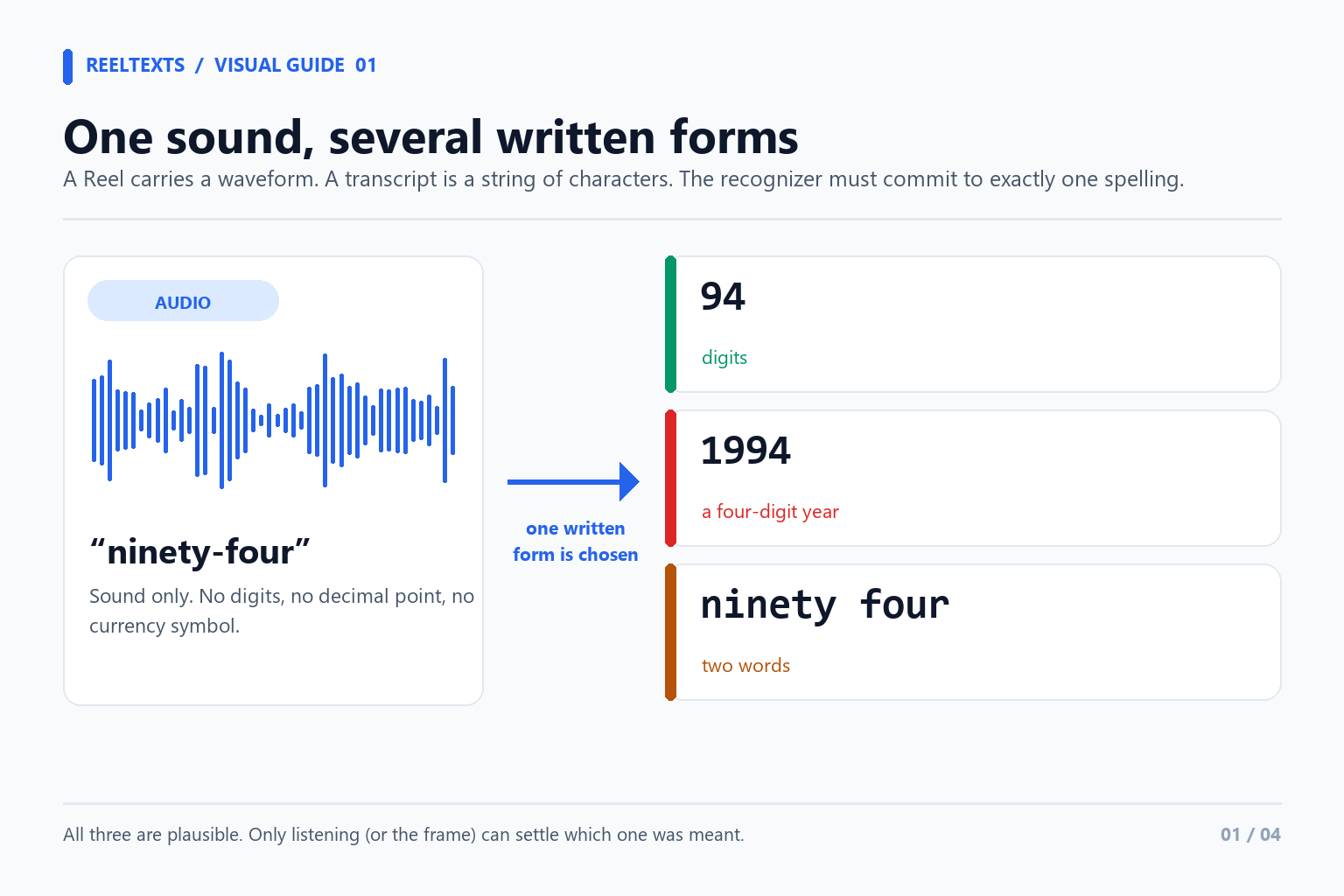
Because there are no digits in audio. A Reel carries a sound like “ninety-four”, and the recognizer has to choose how to spell it. The number in your transcript is a decision about writing, not a copy of a number — which is why a price, a year or a time can come back wrong while the sentence around it reads perfectly.
Main guide: Instagram transcript — paste a link, get the full text. The page you are reading covers one specific case in depth.
Short answer: a speech recognizer maps sound to the most likely word sequence it knows. There is no digit channel in the recording, no arithmetic step after it, and no rule that says “this is a year” or “this is a price”. So the written form is inferred from how numbers usually appear in the model's training text. That inference is why the same sound can land as 94, 1994 or ninety four, and why 2.30 can arrive as three separate tokens. In this site's own local measurements, 94 came back as 1994 in one split run, seventeen became 17 in another, and all three time expressions in one interview clip were split into three tokens each: five o 'clock, 2 .30, 7 .30. None of those is a typo you can fix by reading harder. The fix is a verification pass: find every numeric token, replay the seconds around it, and record the confirmed form before you quote, price or publish anything. Below are the five shapes the error takes, the mechanism behind all of them, and the worksheet.
What actually happened: one sound, several written forms
Start from the object you are holding. A transcript is a string of characters. A Reel is a waveform. Between them sits a model that was trained to predict which piece of text most probably accompanies a stretch of sound. For ordinary words the mapping is tight enough to feel like copying. For numbers it is not, because spoken number systems are ambiguous by design.
“Nineteen ninety-four” is pronounced as two halves, and those same two halves are also how a person says a street number, a score, or two separate quantities. “Two thirty” can be a time, a price, a decimal, or two hundred and thirty said casually. “Fifteen” and “fifty” differ by one syllable under a music bed. The speaker knows which one they meant because they know the context. The model knows only the sound and the surrounding words, and it must still emit exactly one written form.
So it emits the most probable one. Not the correct one — the most probable one. That single distinction explains every number error on this page.
The five shapes a wrong number takes
Every number problem in a transcript fits one of five shapes. Naming the shape matters, because each one has a different check. These examples are drawn from this site's own published local measurements, not from a vendor's accuracy claim, and each is attributed below.
| Shape | What changes | Observed example | Why it is easy to miss |
|---|---|---|---|
| Expanded | A two-part number is reinterpreted as a four-digit year | 94 → 1994 in one split run of the eight-cut experiment |
The result is still a valid number, so nothing looks broken |
| Swapped | A word becomes digits, or digits become a word | seventeen → 17 in the same experiment; 94 / 1994 across runs |
Both forms are correct English, just not the same token |
| Split | One figure arrives as several tokens with stray spaces | five o 'clock, 2 .30, 7 .30 — all three time expressions in one measured clip |
A search for 2.30 returns nothing, so the figure seems absent |
| Skewed | A nearby sound reshapes the number word itself | handwritten → hundred and in several rows of the eight-cut experiment |
The replacement is an ordinary phrase, so it reads as content |
| Lost | A number at a cut or boundary never appears at all | A whole-file phrase with no counterpart in either half, recorded as an unconfirmed mismatch in that experiment | There is nothing on the page to flag; the gap is invisible |
The eight-cut experiment used a 182.96-second synthetic English narration and 24 recognizer calls on a local CPU model. It is a controlled measurement of what one engine outputs, not an Instagram test and not an accuracy rate. The time-expression examples come from a separate five-Reel measurement on this site. Neither establishes how any other tool behaves.
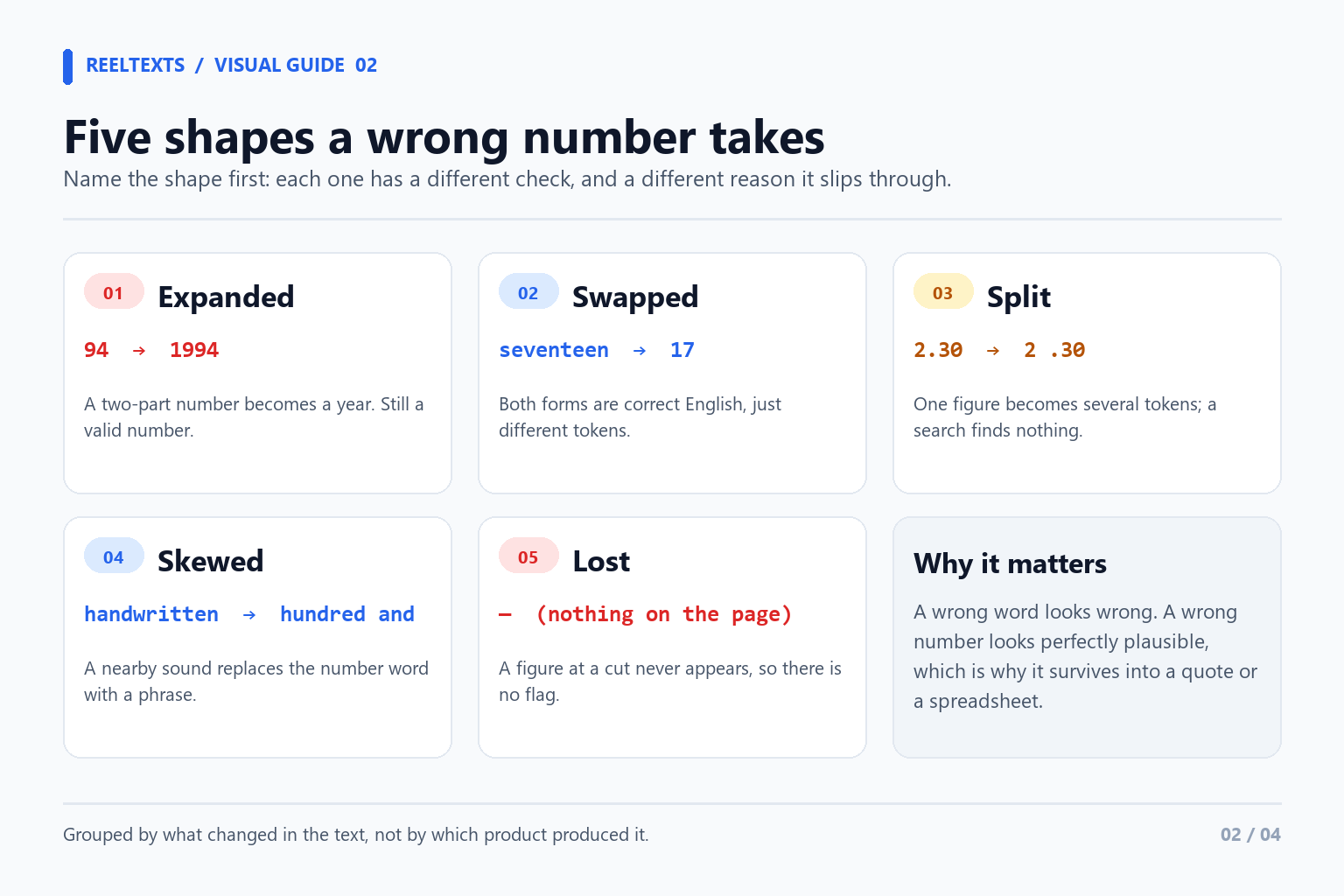
The dangerous shape is the first one. A misspelled word looks wrong. A wrong number looks completely plausible, which is precisely why it survives into a caption, a quote or a spreadsheet.
Why numbers fail more often than the words around them
There is a measured version of this, and it is worth reading carefully because it is narrower than it sounds. In a five-Reel measurement on this site — 353.1 seconds of audio, 1,114 words, transcribed with a local CPU model and asked for a probability per word — tokens containing a digit were rare: 6 of the 1,114 words. One of those 6 scored below the site's 0.6 threshold, a 16.7% rate. Capitalised names ran at 16.1%, function words at 6.2%, and everything else at 5.5%.
Those six tokens are far too small a sample to claim a rate for numbers in general, and this page does not. What the table does show is the shape of the problem: names and digit-bearing tokens together made up 8.9% of the text but held 22% of the doubtful words. Doubt pools on the tokens you cannot guess from the sentence around them. A missing the is recoverable from grammar. A wrong 94 is not recoverable from anything, because every number fits the sentence equally well.
Confidence is also not correctness. The same measurement found one name spelled identically three times in a single clip, scoring 0.58, 0.98 and 0.25 depending on whether it landed over a laugh or a second voice. A number can score high and still be the wrong number. The score tells you where to listen, never what to write.
Where the wording on tool pages stops helping
The three product pages in this category that we read all lead with a single accuracy percentage, a count of supported languages, and a list of export formats. Those are useful for choosing a tool. None of them says anything about what a spoken number becomes, or offers a way to check one. That is not a criticism of those tools — a headline percentage is a summary of a test set, not a statement about the price in the Reel you pasted thirty seconds ago.
The gap is structural: a percentage describes average behaviour over many words, while a transcript is used one sentence at a time. A figure that is 99% reliable across a document is still a figure you cannot paste into an invoice without listening. No accuracy number, from any source, converts a guessed spelling into a verified one.
The worksheet: five checks, in this order
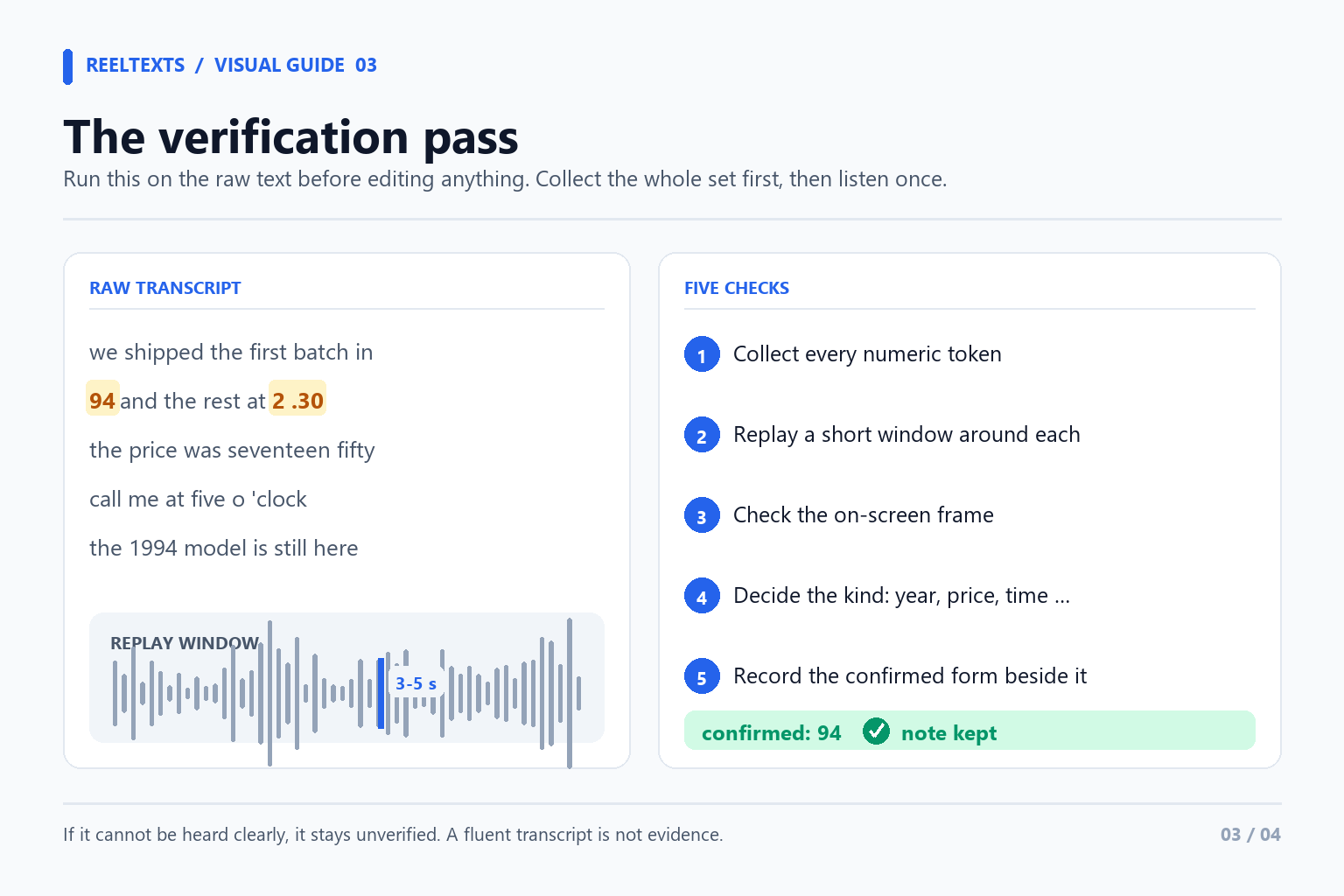
Run this on the raw text before you edit anything. It is deliberately boring and it takes about a minute per Reel.
- Collect every numeric token first. Scan for digits, number words, currency words and anything that names a time. Put them in one list with their surrounding phrase. Do not fix any of them yet — you need the complete set before you start listening, or you will keep finding new ones after you think you are done.
- Replay a window around each one, not the whole clip. Three to five seconds is enough. Listen for the vowel that distinguishes fifteen from fifty, and for whether the speaker said “nineteen ninety-four”, “ninety-four”, or two separate numbers. If the music bed covers it, mark the token as unconfirmed rather than guessing.
- Check the frame, not just the audio. Prices, dates and statistics are frequently printed on screen in a Reel, typed by a person. That on-screen number is a stronger source than the recognizer's spelling. If the frame and the transcript disagree, the frame wins, and you have found an error worth recording.
- Decide the intended kind before you decide the digits. Is it a year, a price, a time, a percentage, a count, a phone number or a model name? The kind determines the written form. “Two thirty” becomes
2:30for a time and2.30for a price, and no engine can tell which one you need. - Write the confirmed form beside the token, and keep the note. Do not silently overwrite it. If the transcript is going to someone else, the note is the only evidence that the number was checked rather than assumed.
One rule sits above all five: if you cannot hear it clearly, it stays unverified. A fluent transcript is not evidence that a number was spoken, and editing a guess only makes it harder to notice later.
Which figures are worth the trouble
Not every number needs a replay. A filler like “a couple of” can be left alone. The rows below are the ones where a wrong spelling changes what the reader does.
| Kind of figure | How it is usually spoken | What tends to come back | Verify against |
|---|---|---|---|
| Price | words, with the currency often implied | bare digits, or a decimal split by stray spaces | the on-screen price and the currency the speaker named |
| Year or date | two halves, e.g. “nineteen ninety-four” | a four-digit year, or two separate numbers | the topic of the sentence and any date shown on screen |
| Time | “two thirty”, “five o'clock” | three tokens with spaces around punctuation | context: a schedule, a duration, or a clock reading |
| Percentage or statistic | a number word plus “percent” | digits that look right but may differ by a syllable | any figure printed in the frame; otherwise replay slowly |
| Phone number or code | digits read one at a time, sometimes in groups | regrouped digits, or words substituted for digits | the frame, or the source the Reel points to — never the transcript alone |
| Product name or model | letters and digits mixed | uppercase and spacing change between runs | the brand's own written form, not the recognizer's |
What a generator can and cannot fix here
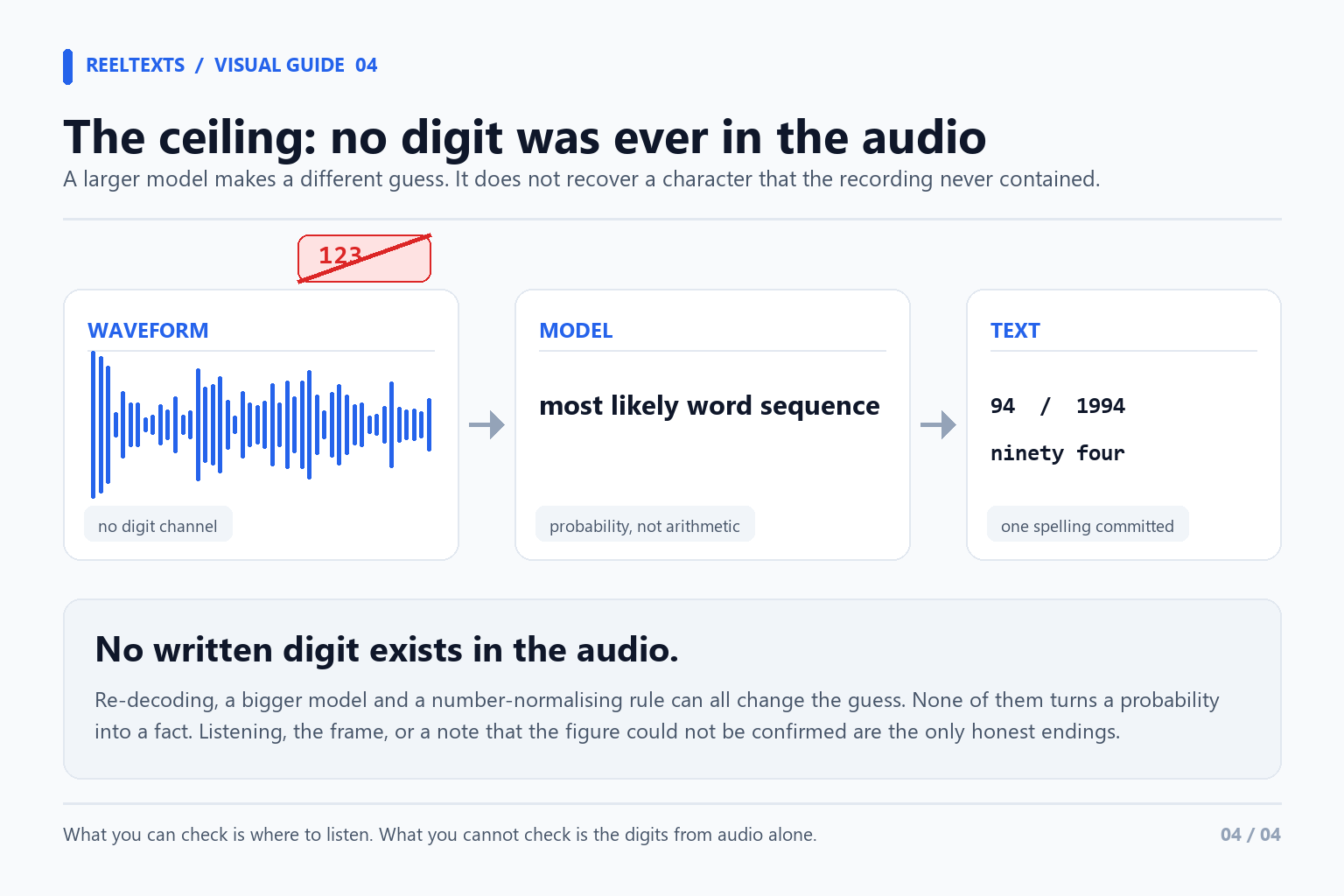
It helps to be blunt about the ceiling. A browser-based generator can return the raw text, expose a per-word confidence if the decoder supports it, and let you re-decode just the window you doubt. All three are useful: the first gives you something to check, the second tells you where to spend attention, the third lets you re-listen to a short stretch without redoing the whole Reel.
What no generator can do is recover a digit that was never in the audio. There is no hidden numeric layer to read. A larger model will make a different guess, and quite often a better one, but it remains a guess — and this site has not tested a larger model on these clips, so no claim is made about one. A post-processing rule that “normalises” numbers can standardise the spelling of a wrong number just as happily as a right one. Neither turns a probability into a fact.
Take the Expanded row in the table above. In one split run of the eight-cut experiment, 94 came back as 1994: that is a recognition-layer mistake, because the engine committed to a four-digit year where the recording held a two-part number. Now put a normalisation step after it. Such a rule does not listen again and does not ask which kind of figure was meant; it takes the string it is handed and writes it in a consistent form, as a display layer applied to the result rather than a second reading of the audio. 1994 is already the tidiest possible shape for that string — four digits, no stray spaces, no word-and-digit mix — so there is no ragged spelling left for the rule to tidy. The wrong number passes through looking more finished than a right number that had arrived as a broken token would.
This is the part worth naming. The table flags the Expanded shape precisely because “The result is still a valid number, so nothing looks broken”, and the Swapped row records 94 / 1994 appearing across runs of the same experiment. Two spellings in front of you are a warning: a reader who sees both knows the engine was guessing. A single standardised output removes that warning. Once only 1994 survives, there is no competing form on the page to set beside it, and the number reads as a settled fact rather than one candidate among several. A misspelled word keeps a visible scar; a legal number has none. Standardisation does not add a second error — it takes away the evidence that would have let you notice the first one.
The reason is that the rule works on a string, not on a sound. It sees characters that look like a year, a decimal or a spoken number and rewrites them to a conventional written form, with no channel back to the waveform and no way to know whether the characters it received were right. That is the same indifference the rest of this page describes from the other direction: seventeen becoming 17, and the time expressions arriving as three tokens, are writing decisions, not copies of digits in the audio. A step that tidies a correct 17 and a step that tidies a wrong 1994 are the same step. The layer that makes a transcript easier to read is also the layer that quietly promotes a guess into a clean, quotable figure.
That is why the worksheet puts “Decide the intended kind before you decide the digits” ahead of any cleanup, and why it asks you to write the confirmed form beside the token rather than silently overwriting it. Do the verification on the raw text, while the ragged spellings and the across-run differences are still visible; after a standardising pass those clues are gone, and a lone 1994 gives you nothing to check it against. One boundary on this section, stated plainly: the measurements quoted on this page report no accuracy rate for numbers in general and did not isolate a normalisation layer as a separate run, so what is described here is a mechanism, not a measured frequency, and it does not establish how any named product behaves. The check still ends where this page has always ended it — with the audio, or with a figure printed in the frame.
What you can check
Was the number spoken at all?
Which word was it: fifteen / fifty?
Which kind: year / price / time?
What does the frame show?
Did I record the confirmed form?
What stays a guess
The exact digits, from audio alone
Whether 94 meant 1994
Where a decimal point belongs
A number lost at a cut
Any figure under a loud music bed
The left column lists checks a person can finish. The right column lists things the recording does not contain, and therefore things no output step can settle.
Scope and limits
The figures quoted on this page come from measurements already published on this site: a five-Reel run of 353.1 seconds and 1,114 words with per-word probability, and a separate eight-cut experiment on a 182.96-second synthetic narration with 24 recognizer calls. Both used local CPU speech models with English selected. The 0.6 confidence threshold was chosen on this site so counts could be repeated; it is not a standard, and the totals move with it. The synthetic narration is not an Instagram recording. Nothing here measures Instagram's own captions, compares commercial products, reports an accuracy rate for numbers in general, or claims a larger model behaves the same way. Where a difference could not be confirmed by independent listening, it is described as a mismatch rather than a lost word.
No traffic, indexing or ranking figures appear on this page, because none were available to read.
FAQ
- Why are the numbers in my Instagram transcript wrong?
- Because audio contains no digits. The recognizer hears a spoken number and chooses the most likely written form from its language model, with no arithmetic or number-type step afterwards. The result is a spelling guess, not a copy of a figure, so a valid-looking number can still be the wrong number.
- Can I fix a wrong number by running the Reel again?
- Sometimes you get a different form, which is useful evidence that the first one was a guess, but it does not tell you which is right. Re-decoding a short window can help you re-listen; the decision still comes from the audio or from a number printed on screen.
- Does a higher accuracy percentage mean the numbers are safe to quote?
- No. An accuracy percentage describes average behaviour over a test set, not the one figure you are about to publish. Numbers are a small share of the words and a large share of the doubtful ones, so a document-level percentage says very little about a specific price or date.
- Why did my transcript split 2.30 into several pieces?
- Punctuation and grouping are produced by the text model, not heard in the recording. A spoken decimal or time has no canonical written form, so it can arrive with spaces around the dot, the apostrophe or the colon. Search for the components as well as the whole string.
- Should I check every number in a long transcript?
- Check every number that a reader will act on: prices, dates, times, percentages, phone numbers, codes and model names. Filler quantities can be left as-is. Collect the full list before you start listening so the pass has a clear end.
- What if the number is covered by music and I cannot hear it?
- Mark it unverified and do not publish it. If the figure is printed in the frame, use that. Otherwise the honest output is a note that the figure could not be confirmed, not a plausible replacement.
How this connects to the rest of the site
Numbers are one failure class among several. Once the figure is confirmed, the same raw text still needs the other checks.
- For names and the first weak spot in a clip, see what breaks first in an Instagram transcript — the per-word confidence table this page draws on.
- For the raw output, its single-paragraph shape and its confidence distribution, see a real transcript, from link to draft.
- For contents of a shared file and missing passages, see the handoff checklist and the error-checking worksheet.
- For the eight split runs quoted above, see the whole-file and split comparison.
- For a different spelling guess that is not about numbers, see why a transcript writes it's and never its.