How do I check speaker labels in an Instagram transcript?
Replay the source Reel at each change of voice, attach a neutral speaker label only when the audio supports it, and leave uncertain turns marked instead of assigning a person's name from context alone.
An Instagram transcript generator can produce useful wording without proving who spoke each line, so review attribution as a separate editing pass before using the text as a quotation or a conversation record.
ReelTexts currently returns plain text, and this guide adds a manual review worksheet rather than promising automatic speaker identification or a speaker-labelled export from the tool.
Keep the source video, untouched transcript and labelled working copy together, and record which version of the video you reviewed before making any attribution changes.
Visual guide: A readable transcript does not identify speakers
Attach labels only when evidence supports the voice; retain uncertainty for overlaps.
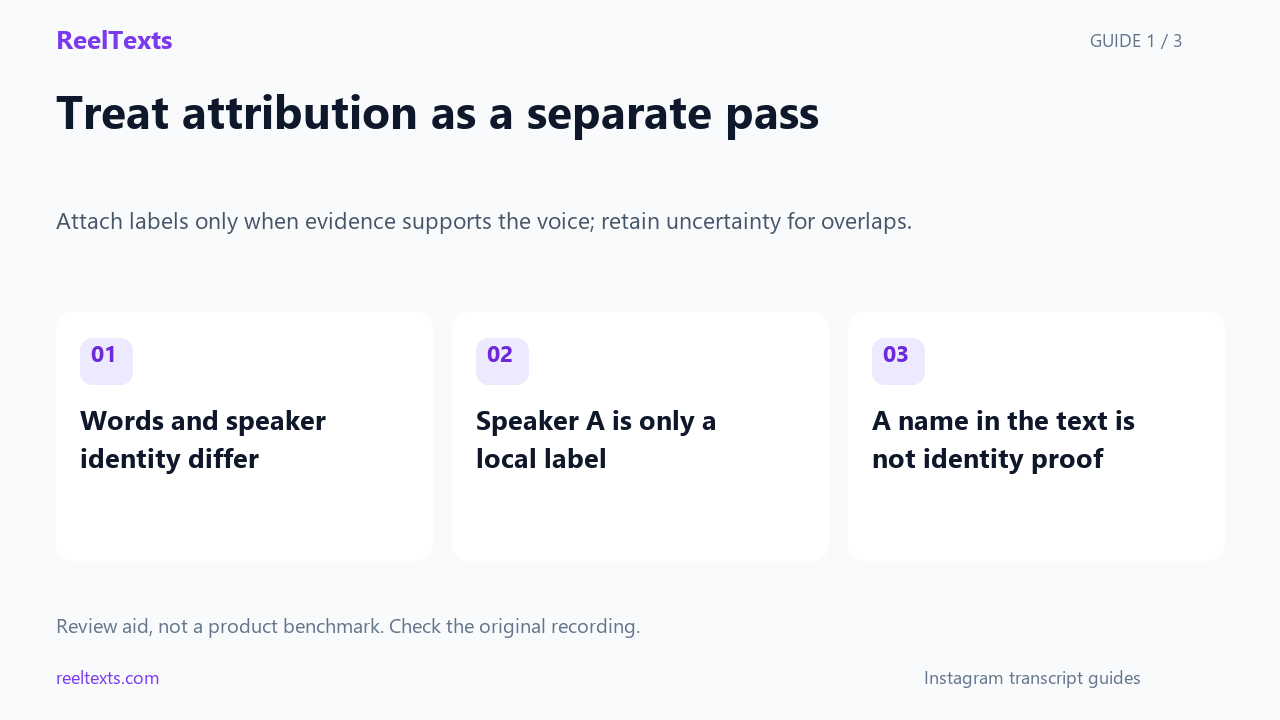
- Words and speaker identity differ
- Speaker A is only a local label
- A name in the text is not identity proof
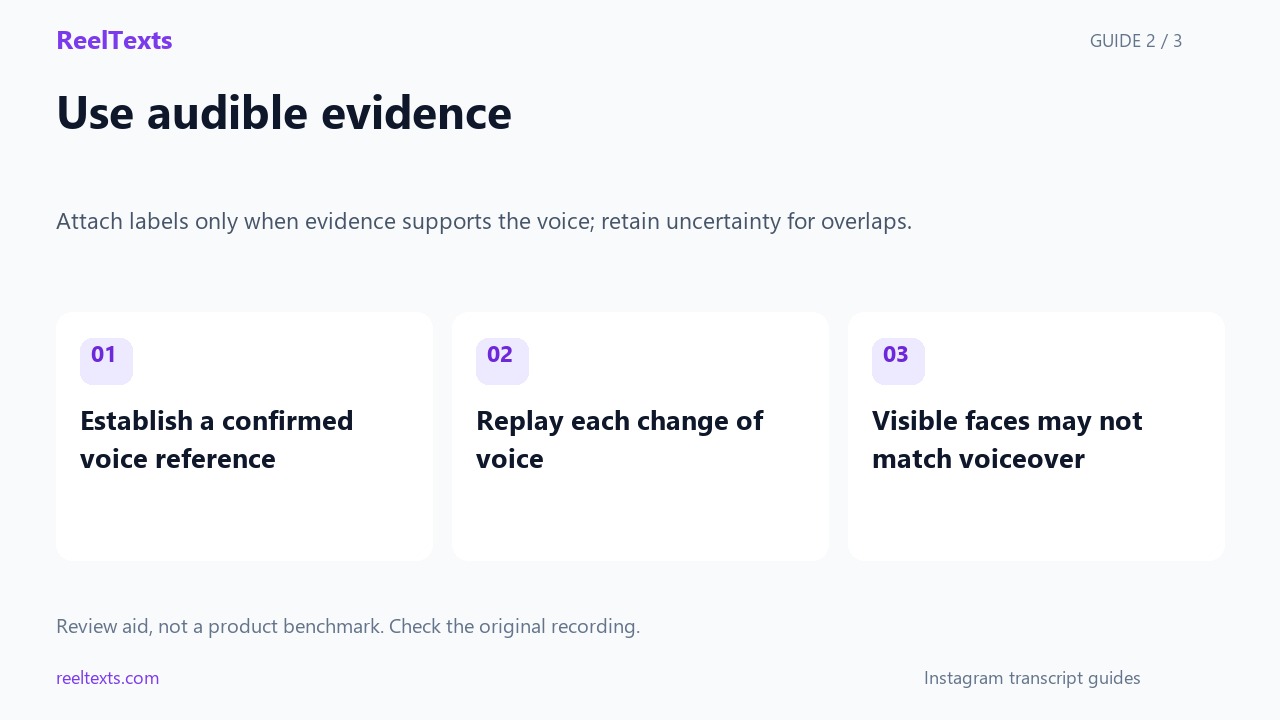
- Establish a confirmed voice reference
- Replay each change of voice
- Visible faces may not match voiceover
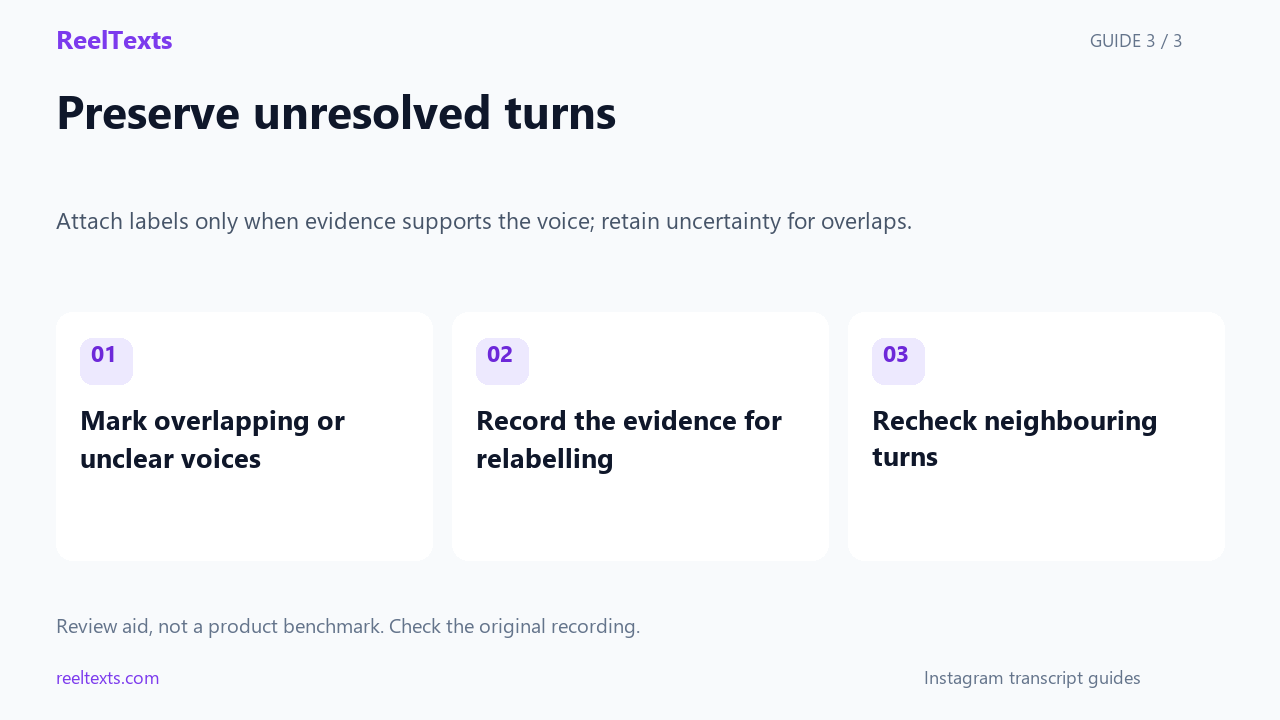
- Mark overlapping or unclear voices
- Record the evidence for relabelling
- Recheck neighbouring turns
Watch the narrated guide
English narration with captions. This guide explains the article; it is not a recorded product test.
Read the narration
Correct wording does not automatically identify who spoke it. Review speaker attribution as a separate pass. A generic label belongs to the reviewed file, and a name mentioned in a sentence is not proof of the speaker identity.
Establish a voice reference from a passage you can identify with adequate evidence. Compare later turns with that reference. A visible face can be a clue, but edited footage and voiceover mean it is not enough on its own.
Mark overlapping or unclear speech instead of assigning it to one person without support. Record the evidence behind each label change. Replay neighbouring turns after an edit. ReelTexts provides plain text, not automatic verified speaker identification.
An invented attribution exercise
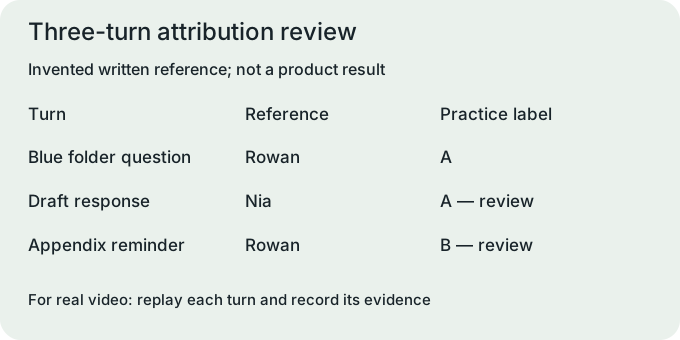
In this invented Rowan-and-Nia exercise, Rowan asks whether the blue folder is ready, Nia answers that the draft is ready, and Rowan adds that the appendix still needs checking.
The three supplied reference turns are Rowan, Nia and Rowan, but deliberately imagine a working copy labelled Speaker A, Speaker A and Speaker B to practise finding an attribution swap.
Map Speaker A to the first confirmed Rowan turn in the exercise, then mark the second turn as needing review rather than assuming that the same label belongs to every sentence in the paragraph.
Use the supplied written reference to correct the exercise's second turn to Nia and its third turn to Rowan, but label these decisions as written-reference practice because no recording accompanies this example.
Review a real conversation
For your real Reel, establish a voice reference from a passage where you can identify the speaker with adequate evidence, then compare that reference with each later turn.
A face visible in the frame is a clue to investigate, not sufficient evidence that the person is speaking, because the clip may contain voiceover, an off-camera participant or edited footage.
Log five fields for each questionable turn: its playback location, current label, proposed label, evidence supporting the change and the status after listening again.
If two people speak together and you cannot separate their words confidently, mark the overlap and unresolved attribution in the working copy rather than silently assigning the whole passage to one voice.
Check short replies separately from longer statements, since a brief response can be easy for a reviewer to overlook even when the surrounding paragraph reads smoothly.
After relabelling a turn, replay the preceding and following turns to confirm that your change did not move the mistake to the next sentence.
Keep uncertainty notes visible in your private review copy, and resolve them before publishing a named quotation or retain an explicit attribution limitation in the material you share.
Do not treat a fluent rewrite or another model's confident speaker guess as confirmation of identity; return to the recording and seek clarification from the creator when necessary.
Questions and answers
Can I identify a speaker just because their name appears in the words?
No: a person can mention somebody else, so the wording alone does not establish that the named person is talking.
Do Speaker A and Speaker B automatically mean the same people across different videos?
No: treat those labels as local to the reviewed file unless you have separately verified their identities across the recordings.
Is the Rowan-and-Nia exercise a product accuracy test?
No: it is an original invented reference for practising review decisions and supplies no measured result about any transcription service.
Technical background: Speaker diarization and generic labels.