How do I check that a shared Instagram transcript has no missing paragraphs?
Keep an untouched reference export, compare the received text with that reference from beginning to end, and use a file checksum when you need to check an exact byte-for-byte handoff.
A complete-looking copy is not evidence that every paragraph arrived, so check the opening, a distinctive middle passage and the ending before treating an Instagram transcript as ready to share.
This workflow checks whether a copy preserved your chosen reference; it does not establish that the reference itself contains every word from the video.
First review your reference export against the source recording, because an Instagram transcript generator can produce text that still needs a separate spoken-word accuracy check.
Visual guide: Verify the file you handed over
Compare the chosen reference, not an unverified video transcript.
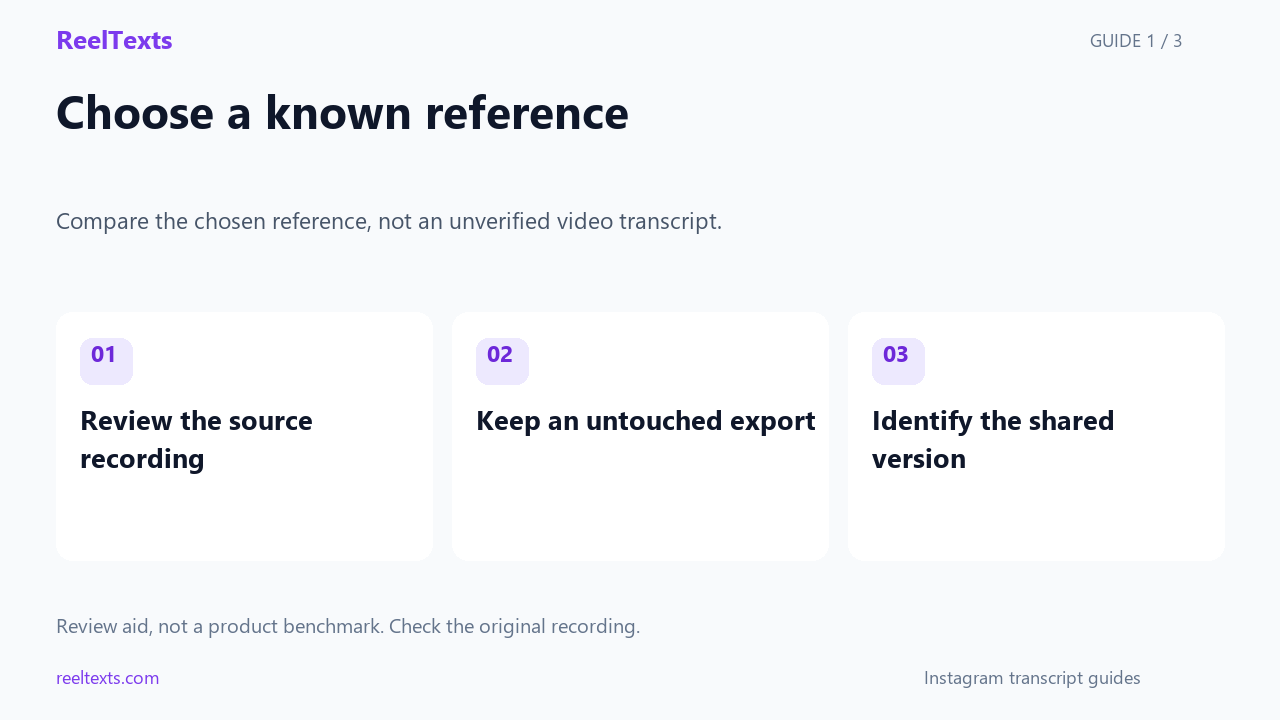
- Review the source recording
- Keep an untouched export
- Identify the shared version
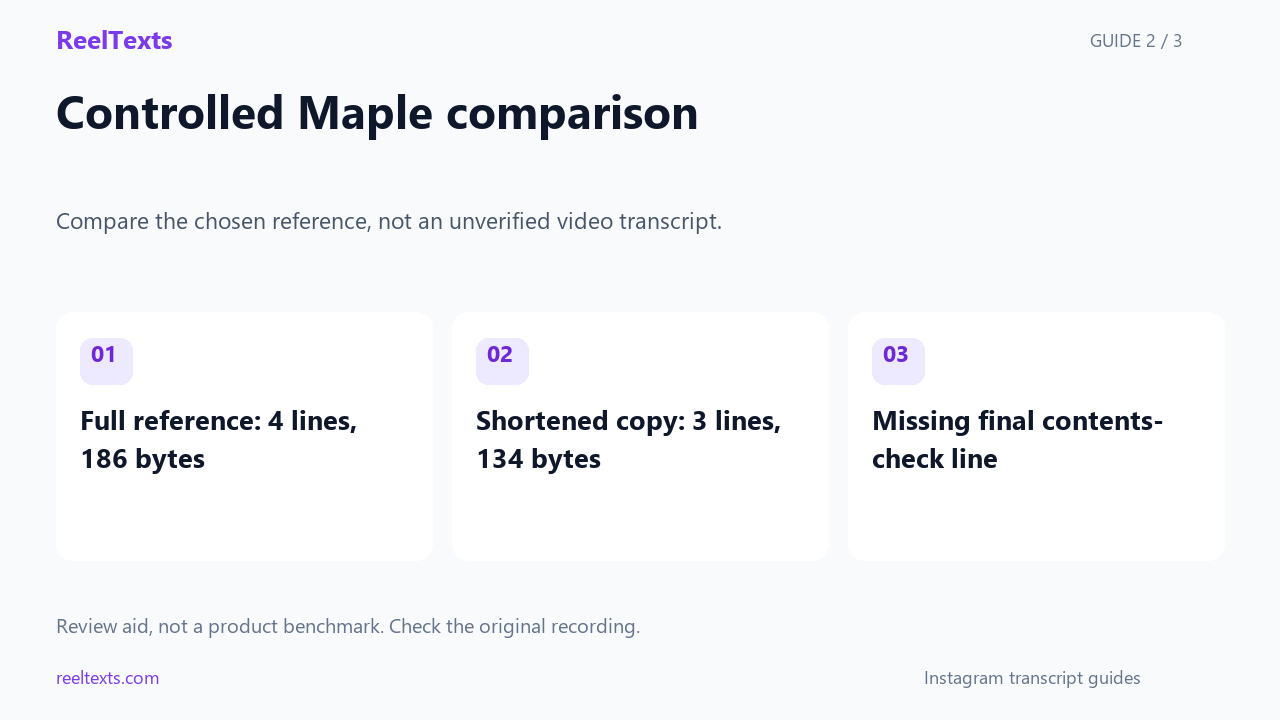
- Full reference: 4 lines, 186 bytes
- Shortened copy: 3 lines, 134 bytes
- Missing final contents-check line
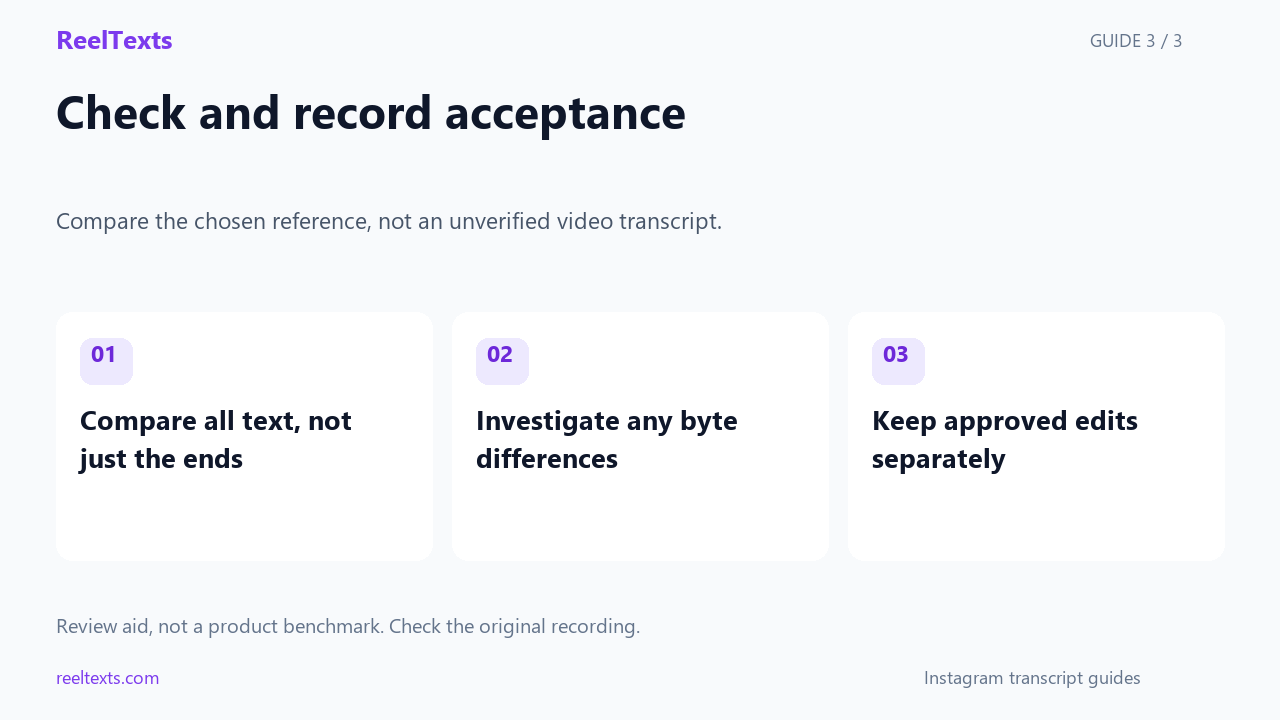
- Compare all text, not just the ends
- Investigate any byte differences
- Keep approved edits separately
Watch the narrated guide
English narration with captions. This guide explains the article; it is not a recorded product test.
Read the narration
Choose an untouched reference export and identify its version before sharing an Instagram transcript. A copy that looks finished can still need a full comparison; check the reference against the source recording separately.
Our controlled Maple exercise has a four-line file and a second file missing the final contents-check instruction. The unchanged byte copy has the same digest, while the shortened practice copy differs; this is a local file exercise, not a video transcription benchmark.
Record the received version and compare the complete text, keeping any intended edits in a separate reviewed copy. A checksum difference calls for investigation, and a matching file comparison does not prove that every spoken word was transcribed.
A controlled file handoff exercise
Our controlled Maple handoff exercise starts with four original labelled lines about a green folder, its appendix, a noon deadline and a final contents check.
We wrote those lines to a local UTF-8 file containing 186 bytes, then created a second file by retaining only the first three lines; that second file contains 134 bytes.
The complete practice file ends with Maple handoff 4: Reply after checking the contents, while the shortened practice file stops after the instruction about sending both items before noon.
An identical byte copy produced the same SHA-256 digest in our local exercise, whereas the deliberately shortened three-line file produced a different digest.
These results come from a controlled file comparison, not an Instagram transcription test, and the original practice lines are not a transcript recovered from somebody's video.
Compare the version you actually shared
Record the reference filename and its version before handing it over, then ask the recipient to compare their received copy with that specific version rather than whichever file happens to be newest.
If you are comparing TXT files without intended edits, a SHA-256 check gives you a reproducible comparison of their bytes, using a tool that calculates the digest from each file.
If the digests differ, investigate the difference rather than assuming a paragraph was lost, since changed line endings, encoding or an intentional edit can also change file bytes.
Inspect a distinctive beginning, middle and final passage as a quick review aid, then compare the full text when completeness matters; three matching snippets cannot rule out an omission elsewhere.
For the Maple practice handoff, put the full file's final contents-check line in an ending-check field and mark the shortened copy incomplete because that specific reference line is absent.
Keep the four original Maple line identifiers in your practice worksheet, because an editor's visual wrapping can show several screen lines for one source line without adding any new text.
Place any proposed wording edits in a separate reviewed version, leaving the handoff reference unchanged so an exact-copy check is not confused with approving a revision.
At acceptance, record which reference version was checked, whether an exact file comparison was required and which differences were intentionally approved by the sender and recipient.
Questions and answers
Can matching opening and closing sentences prove that every paragraph arrived?
No: compare the complete text, since a middle section can be omitted while both ends remain present.
Does a matching checksum prove that the transcript matches the video?
No: it checks the chosen file comparison, and spoken-word completeness still requires reviewing the recording.
Controlled exercise files: Full practice reference · Shortened practice copy · Computed comparison record
Technical reference: Python hashlib