Review Repeated Words in an Instagram Transcript
To review repeated words in an Instagram transcript, replay the passage, choose a verbatim or edited style, and remove a repetition only when the edit preserves the speaker's meaning.
Keep an untouched source copy before cleaning repeated words so another reviewer can trace what changed.
An Instagram transcript generator can give you text to review, but duplicate-looking words are not automatically transcription mistakes.
A repeated word can be a restart, an emphasis, or part of a repeated instruction, so a global delete rule is a poor substitute for playback.
Full verbatim and lightly edited transcripts use different conventions; agree on the intended style before cleaning the text.
Rev's published guide distinguishes verbatim repetition from readability edits and requires meaning to remain intact.
Visual guide: Review before deleting repetition
Keep repeated meaning even when you clean repeated words.
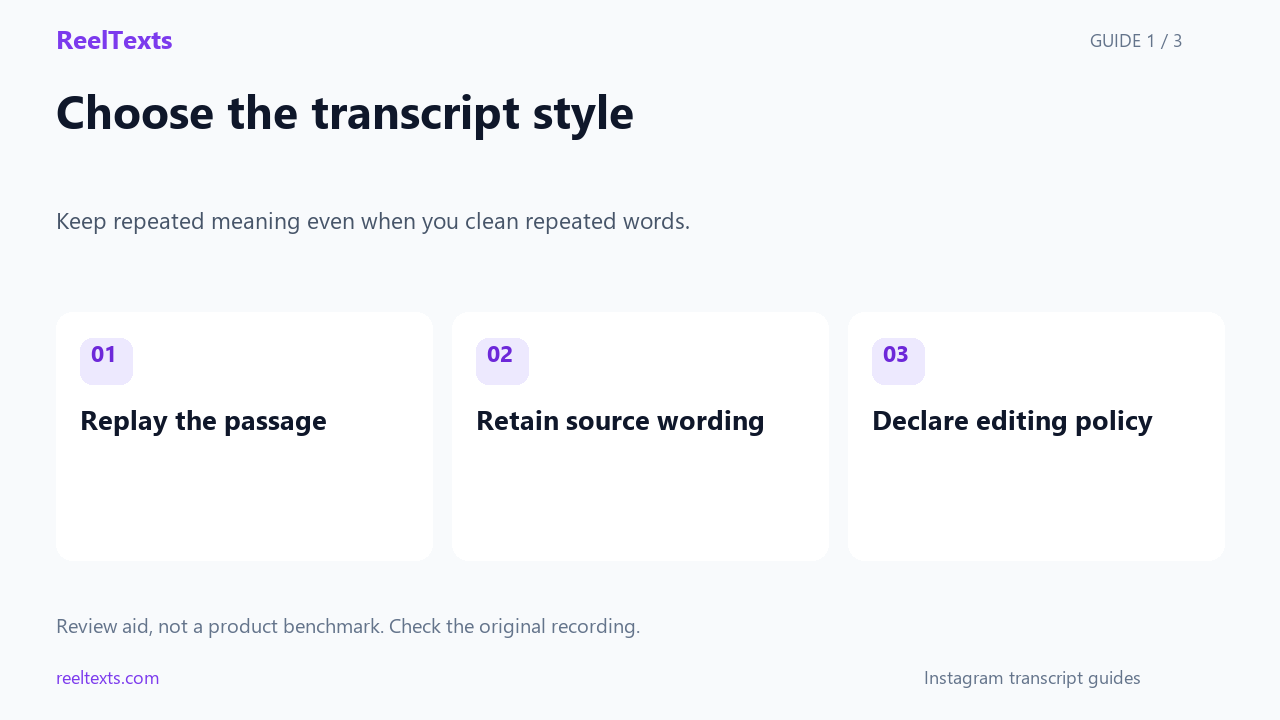
- Replay the passage
- Retain source wording
- Declare editing policy
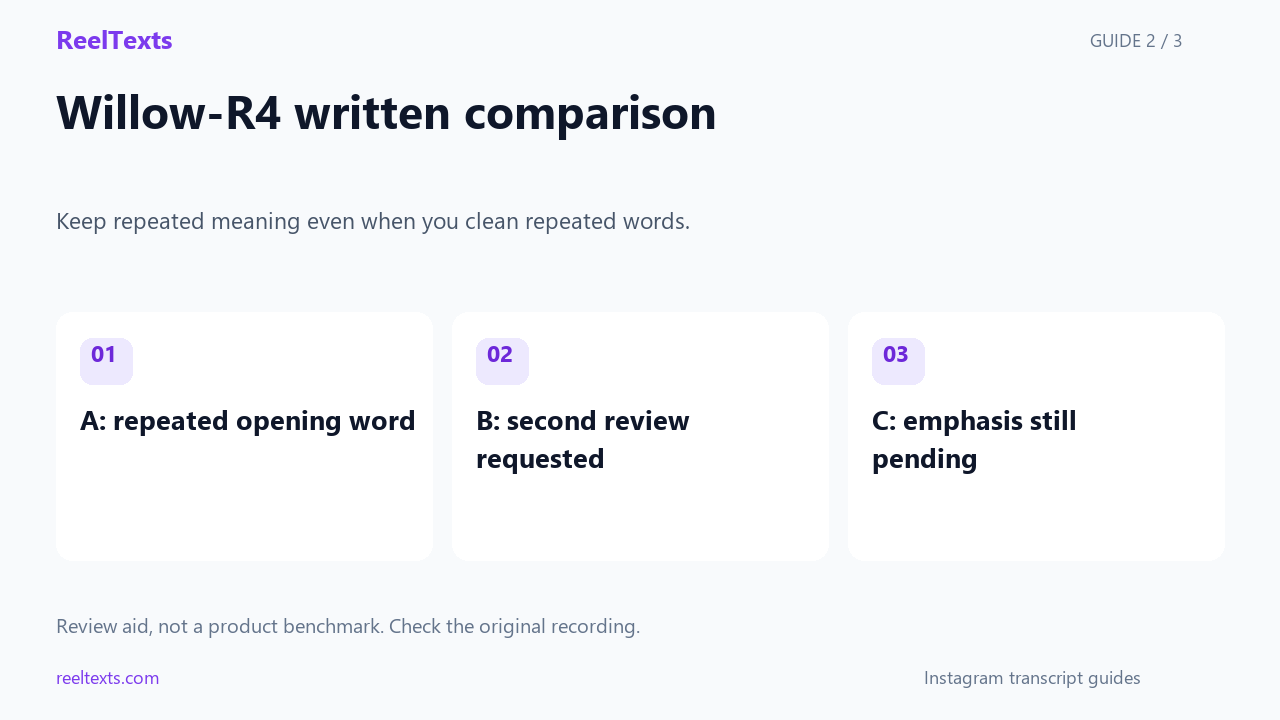
- A: repeated opening word
- B: second review requested
- C: emphasis still pending
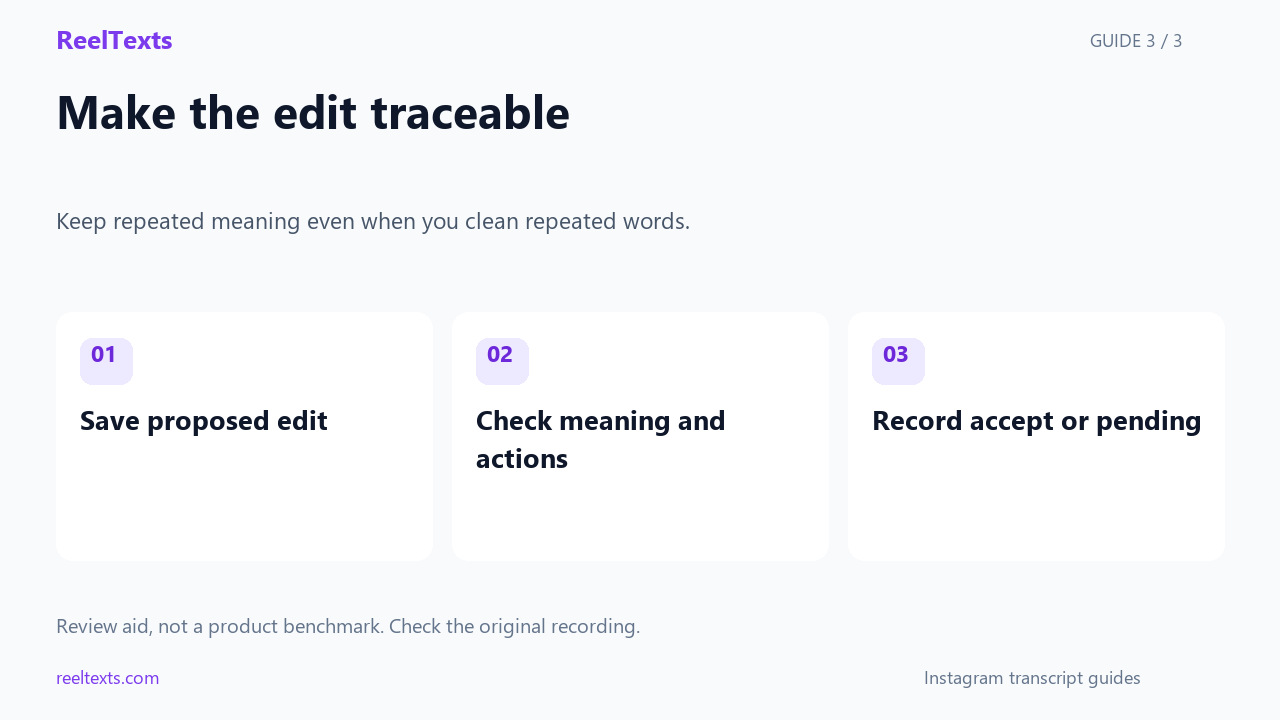
- Save proposed edit
- Check meaning and actions
- Record accept or pending
Watch the narrated guide
English narration with captions. This guide explains the article; it is not a recorded product test.
Read the narration
Review repeated words by replaying the source and choosing the intended transcript style before editing. Our written Willow-R4 pack separates a repeated opening word, an explicit second review, and an unresolved emphasis case.
The first case illustrates a declared readability edit, while the second keeps the word again and the second requested action. The emphasis case stays pending because the written fixture has no original recording to settle the delivery.
Save the source, proposed edit, meaning check, and decision separately so another reviewer can inspect each change. This is a written teaching exercise, not a transcription benchmark, and no automatic cleanup rule is being tested on real audio.
Willow-R4 written practice
The Willow-R4 practice pack uses three written lines to separate a repeated word from a repeated action.
Willow-R4 line A reads Open, open the note, and its edited practice version reads Open the note.
Willow-R4 line B reads Review both headings, then review both headings again, and its accepted version keeps the second review.
Willow-R4 line C reads This is very, very useful, and its review decision stays pending until the intended emphasis is checked.
The Willow-R4 pack has no original audio, so none of its written decisions claims to identify how a real speaker sounded.
Use Willow-R4 line A only as a declared editing exercise, not as evidence that all repeated opening words are disposable.
Willow-R4 line B includes the word again, which explicitly asks for another review rather than merely duplicating a token.
Deleting the second Willow-R4 review would change the requested action count from two reviews to one review.
Willow-R4 line C deliberately leaves the emphasis question unresolved because printed words alone do not settle the speaker's delivery.
Record the editing decision
The Willow-R4 worksheet stores the source line, proposed edit, intended style, meaning check, and review decision in separate fields.
Mark the Willow-R4 A decision as an exercise-approved readability edit under the declared practice style.
Mark the Willow-R4 B decision as retain because its second action is explicitly requested in the source wording.
Mark the Willow-R4 C decision as pending rather than giving an invented confidence score for emphasis.
Keep the Willow-R4 rejected B edit beside the accepted B line so the removed second action remains visible to the reviewer.
Before approving your own edit, compare action counts, qualifiers, and emphasis against the actual recording.
Do not replace a source repetition with cleaner wording inside a quotation without making the editing policy clear.
If a client requests full verbatim, follow that request instead of applying a general readability cleanup.
Can I automatically collapse adjacent identical words?
Questions and answers
A duplicate-word alert can flag a place to review, but it cannot establish whether the repetition was intended.
Is a repeated instruction the same as a stutter?
No, an instruction that explicitly asks for another action must be reviewed as an action, not just as repeated text.
What should I do when emphasis is unclear?
Keep the source wording and mark the edit pending until you can review the delivery or obtain a style decision.
Save the approved edited copy separately and record which repeated spans changed and why.
Reproduce the practice review
The Willow-R4 acceptance ledger uses identifiers A-source, A-edit, B-source, B-rejected, and C-pending to keep each decision traceable.
A Willow-R4 token-count comparison can demonstrate that a word disappeared, but it cannot prove that the editing decision preserved meaning.
The Willow-R4 action-count comparison for line B is a deliberately specified teaching check with an expected value of two reviews.
Run the Willow-R4 rejected B line through the same practice check and record its expected value of one review.
Preserve both Willow-R4 B results instead of overwriting the failure after repairing the shortened instruction.
A Willow-R4 reviewer should reject an acceptance record that labels the pending C case as verified emphasis without any audio.
The Willow-R4 source-retention field confirms that all three written source strings remain available after the edits.
Do not turn Willow-R4's three cases into an accuracy percentage for any Instagram transcript generator.
When adapting Willow-R4 to a real clip, replace the written case identifiers with links to source passages you have actually replayed.
Add a reason to each Willow-R4 edit record so the next reviewer can distinguish a style choice from an accidental deletion.
The Willow-R4 final checklist asks whether the edited line preserved the requested work, retained needed qualifiers, and kept unresolved emphasis visible.
Archive the Willow-R4 rejected version as a counterexample rather than publishing it as the recommended cleanup.
Repeated words alone do not establish a speaker's intention, and the Willow-R4 pack intentionally exposes that limitation.
Use the Willow-R4 practice files to rehearse review decisions before applying the worksheet to your own checked Instagram transcript.
Practice files: practice-pack | accepted | rejected | checks
Style reference: Rev transcription style guidance.
Related reader question: Repetitions and false starts.