Replay the recording alongside the generated text, compare uncertain phrases with their surrounding speech, and record each correction before editing the transcript.
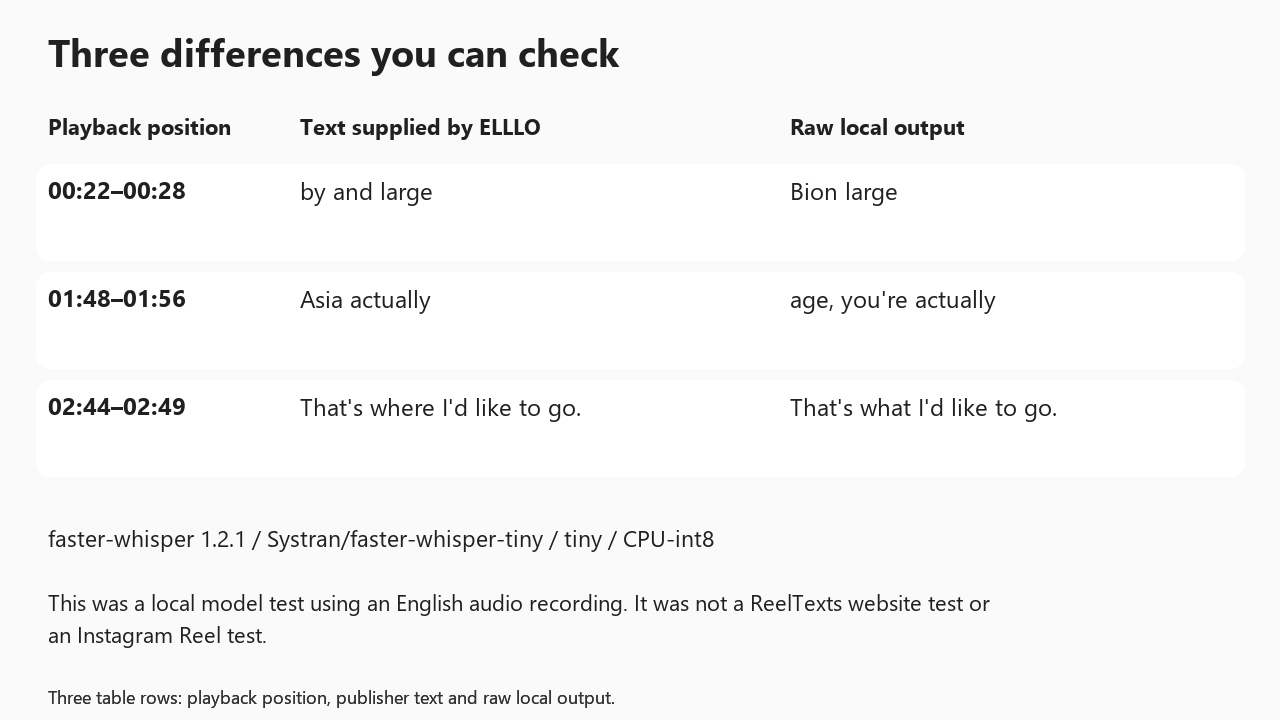
The examples below show three differences between a publisher’s transcript and a locally generated transcription of the same audio. Each includes the source and a playback position so you can check it yourself.
What was tested?
The source is ELLLO’s Mixer #19 Travel Wish List, an English recording featuring six people speaking in turn. Its measured duration is 3 minutes 31 seconds.
The reference excerpts come from ELLLO’s published Script. The generated excerpts are unchanged outputs from a local run of faster-whisper 1.2.1, using Systran/faster-whisper-tiny, the tiny model, on CPU with int8 computation.
The run used English language selection, one CPU thread, beam size 1, temperature 0, no previous-text conditioning, and no voice activity filter.
This was a local model test using an English audio recording. It was not a ReelTexts website test or an Instagram Reel test. ELLLO’s text is the publisher-provided reference, not a separately verified human annotation.
Three differences you can check
The playback windows below follow the model’s segment boundaries. The links open the original audio with a time fragment; if your player does not seek automatically, move to the listed position.
| Source | Playback position | Duration | Language | Speakers | Text supplied by ELLLO | Raw local output — faster-whisper 1.2.1 / Systran/faster-whisper-tiny / tiny / CPU-int8 | What differs |
|---|---|---|---|---|---|---|---|
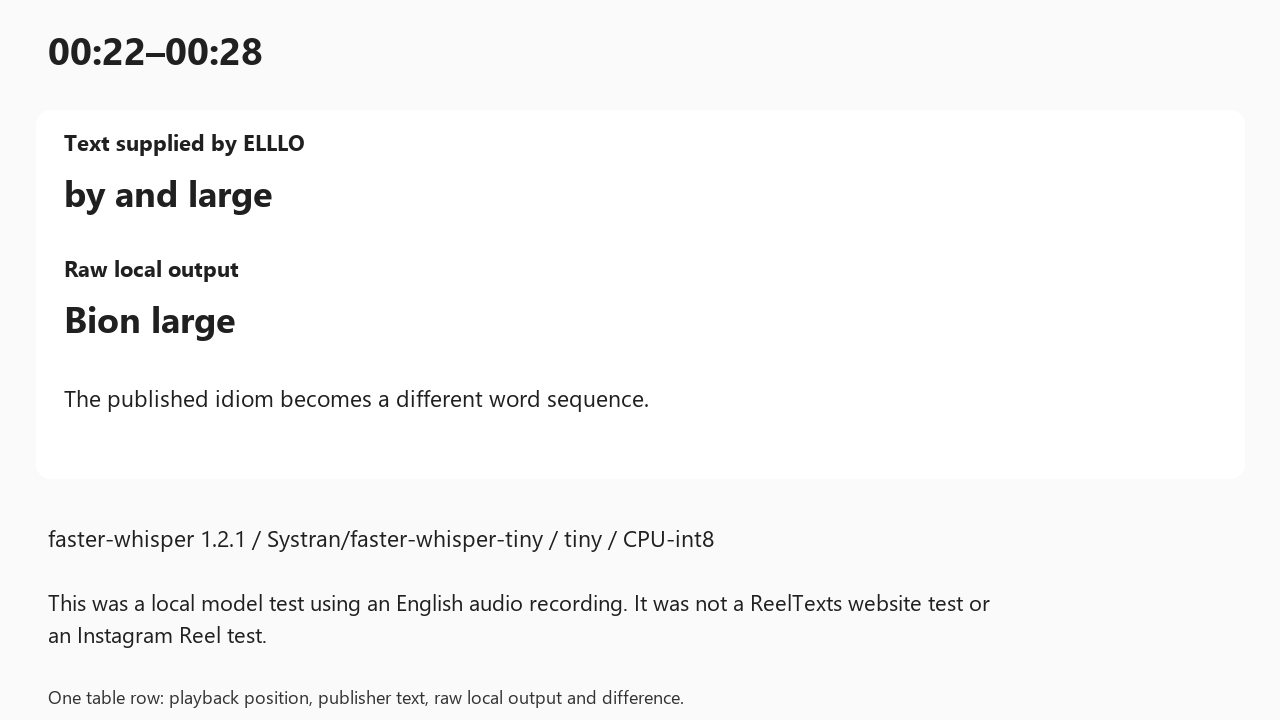
| Original audio | 00:22–00:28 | Full recording: 3 min 31 sec | English | 6 in the full recording, speaking in turn | by and large | Bion large | The published idiom becomes a different word sequence. |
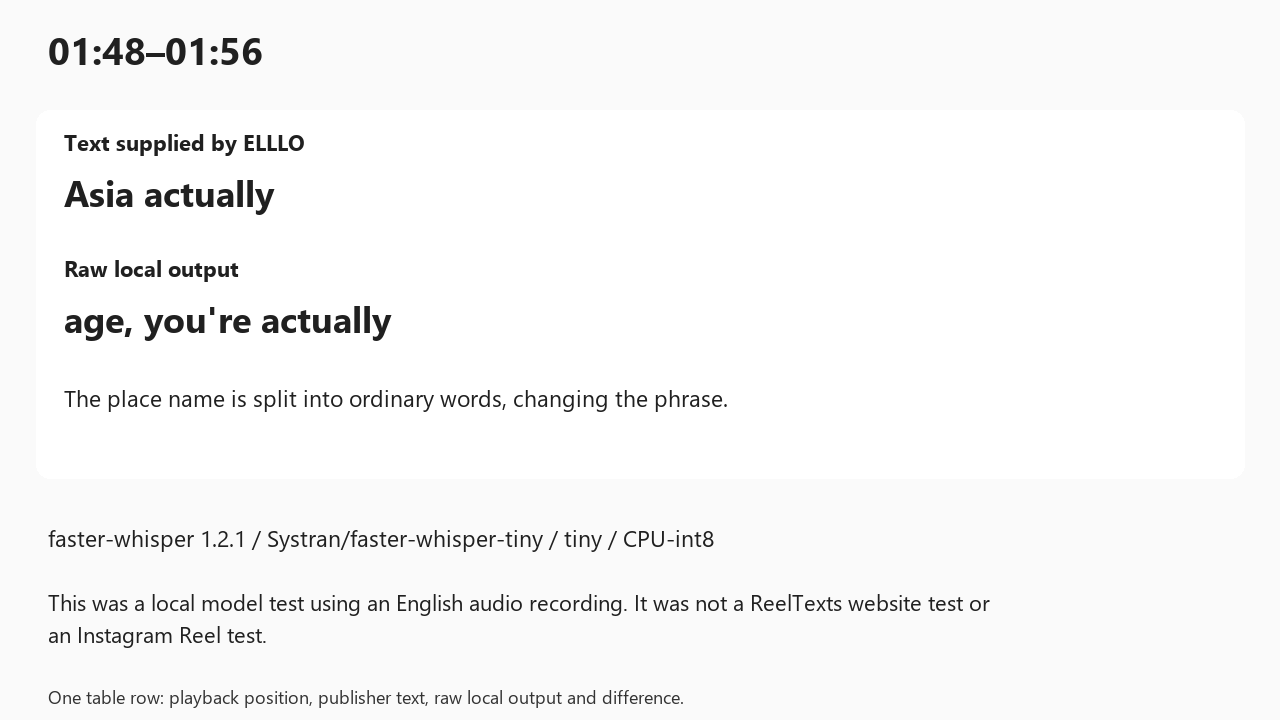
| Original audio | 01:48–01:56 | Full recording: 3 min 31 sec | English | 6 in the full recording, speaking in turn | Asia actually | age, you're actually | The place name is split into ordinary words, changing the phrase. |
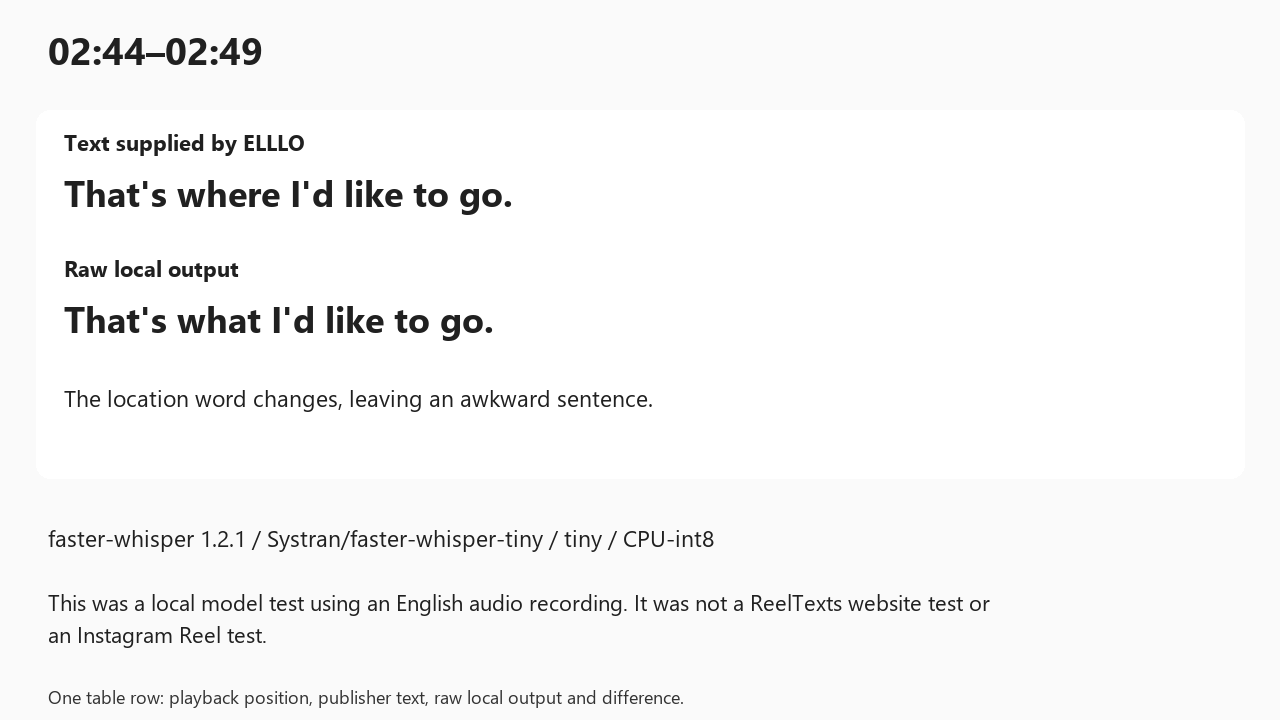
| Original audio | 02:44–02:49 | Full recording: 3 min 31 sec | English | 6 in the full recording, speaking in turn | That's where I'd like to go. | That's what I'd like to go. | The location word changes, leaving an awkward sentence. |
How to review these differences
For the first excerpt, listen across the whole expression rather than judging the unfamiliar token in isolation. Compare the sound with the publisher’s wording before accepting a replacement.
For the second excerpt, start with the preceding sentence about travel. Then replay the transition into the disputed phrase. The surrounding topic helps you locate the issue, but the recording must support the correction.
For the third excerpt, pay attention to the short word after the contraction. Flagging an awkward sentence can identify a place to review; it does not establish which replacement is correct.
Apply the same process to your Instagram transcript: preserve the generated wording, locate the disputed speech, and keep the correction linked to its evidence. If you use a written reference, identify who supplied it rather than presenting it as something you personally verified by listening.
What these examples establish
These are three observed text differences from one recording and one local model configuration. They provide specific phrases to investigate and demonstrate how to make a correction traceable.
They do not establish an accuracy rate, compare transcription products, or measure performance on overlapping speech. The speakers take turns, and this recording does not test Instagram-specific audio conditions.
Keep the evidence attached to the correction
A reader should be able to move from the disputed wording to the recording and back without guessing which passage was tested. For these examples, the source audio, playback windows, publisher text, model identity, and unchanged generated excerpts remain together.
Original contribution on this page: the local run’s three timestamped output excerpts, their side-by-side comparison with ELLLO’s published text, and the explanation of the specific difference in each excerpt. The recording and reference transcript belong to their original publisher.