Eight audio cuts: whole-file and split transcription compared
Splitting this prepared narration changed recognized text, and four left-hand chunks returned endpoints beyond their own audio; the eight whole-file runs also returned an endpoint slightly beyond the full input.
The recording is 182.961406 seconds long: just over three minutes. It is synthetic English narration made locally with Microsoft Zira Desktop at rate minus one, not an Instagram recording. The cut locations come from recorded synthesis word-boundary events, with a separate cut inside an inserted two-second interval of zero samples. Sentence-boundary cuts are at the next sentence's word onset; they are not manually located phonetic endings.
We used cached faster-whisper tiny revision d90ca5fe260221311c53c58e660288d3deb8d356, CPU int8, one thread, one worker, beam size one, English selected and VAD disabled. Each of the eight cuts has a fresh whole-file run and two half-file runs: twenty-four calls, once per input. There is no overlap between halves. This remains one experiment with eight cut locations, not eight unrelated benchmarks.
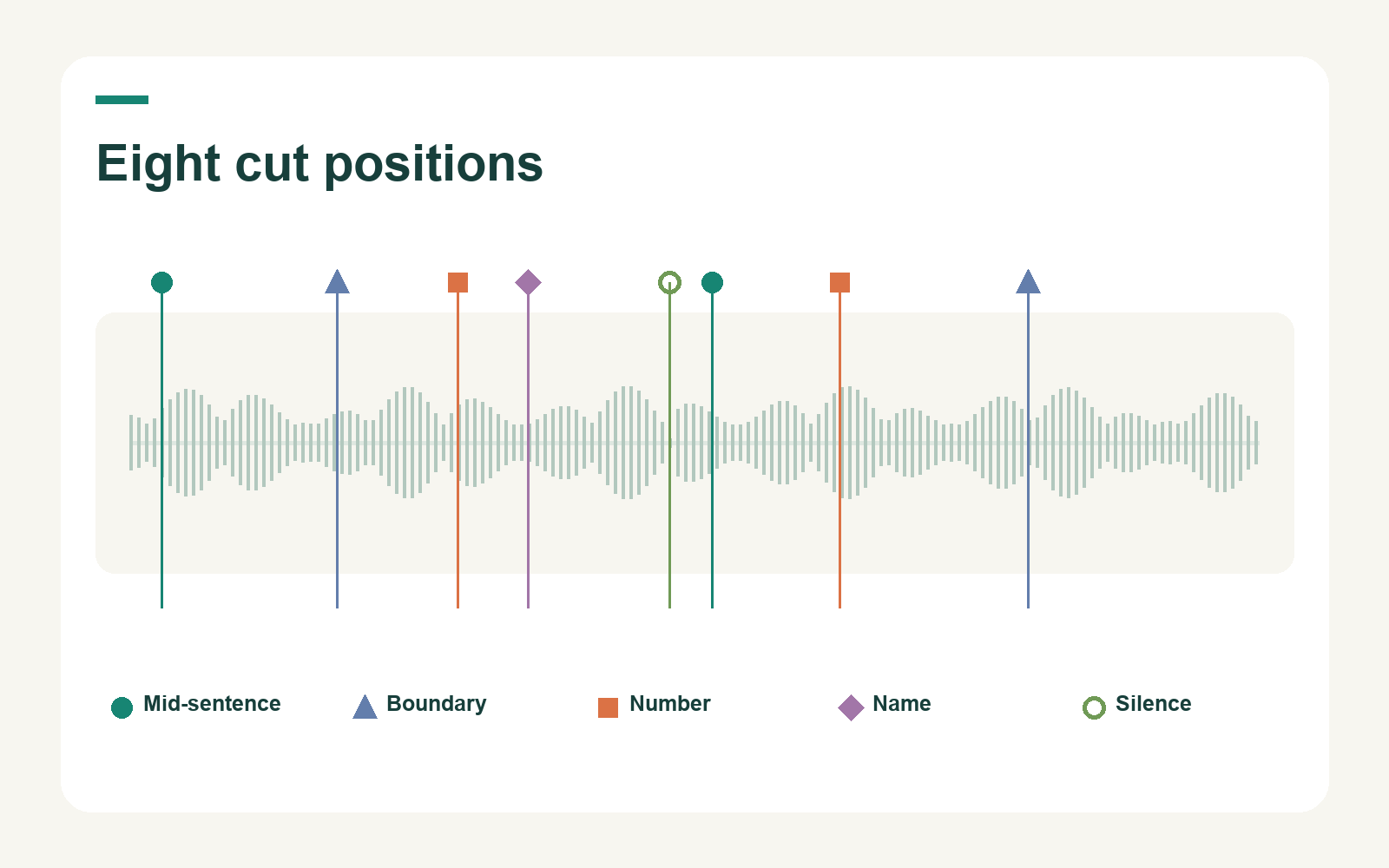
Eight cuts, four recorded fields
Arrows show whole-file output followed by split output. An empty symbol marks an empty aligned span. A text difference is not automatically a speech error: there is no independently listened reference transcript. The comparison covers complete outputs, so a difference listed here may occur away from the cut. Exceedance is calculated as the positive part of returned endpoint minus input duration; those calculated values are excluded from the original-measurement word count.
| Missing word | Word that differed | Timestamp outside its own input, seconds | Where the cut landed |
|---|---|---|---|
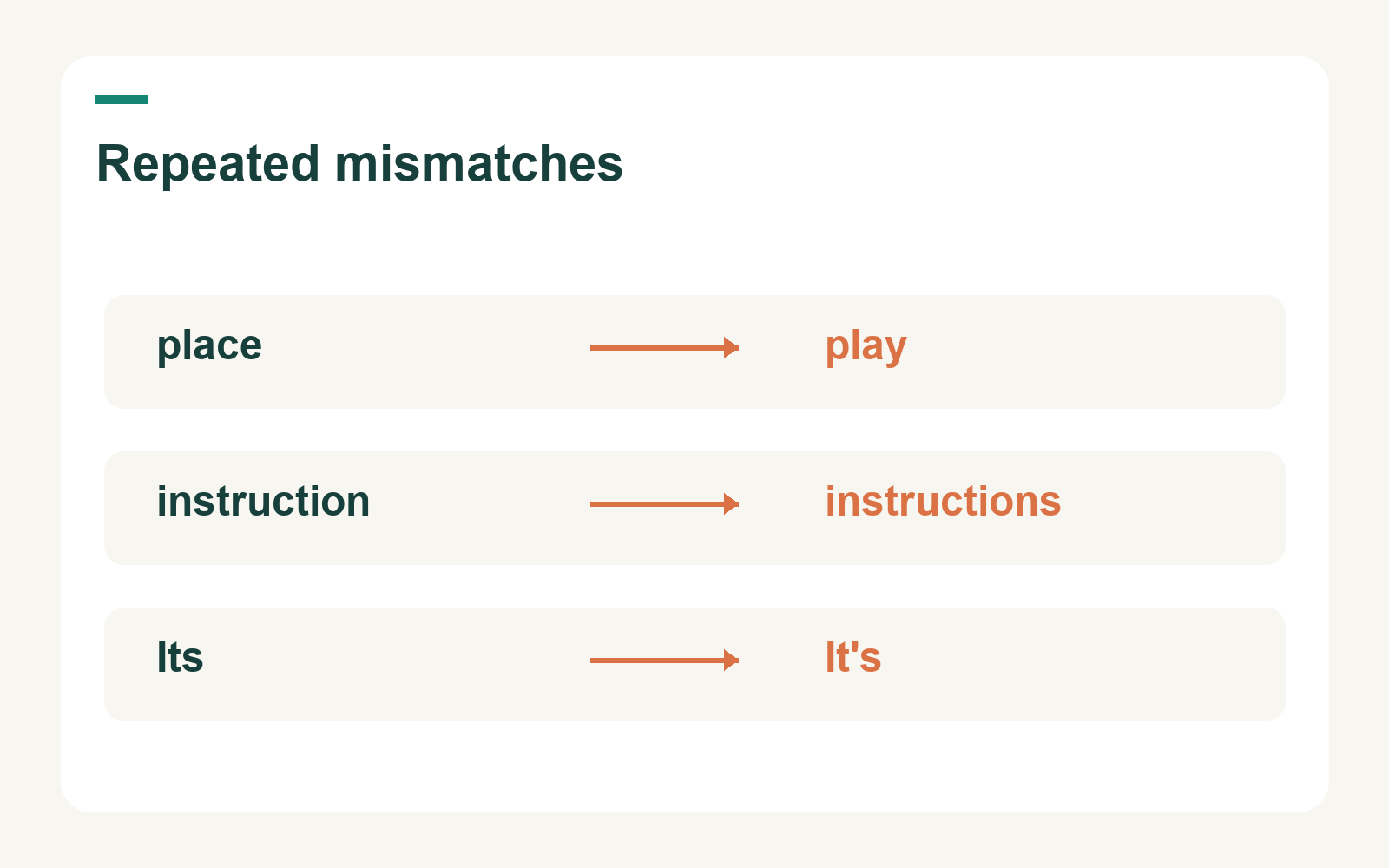
| Not confirmed: no whole-only span in this comparison. | and checked → and... check; 94 → 1994; It's → Its | left 0.000 (end 5.0 / input 5.166); right 0.000 (end 176.96 / input 177.795) | mid-sentence, inside the word beside, at 5.166 s |
| Not confirmed: no whole-only span in this comparison. | ∅ → f-; play → place; handwritten → hundred and; instructions → instruction; It's → Its | left 0.463 (end 34.0 / input 33.537); right 0.000 (end 148.56 / input 149.425) | sentence boundary, immediately before Tomorrow, at 33.537 s |
from INSTagram. — not confirmed (whole run only, nothing in either half). | play → place; a → a...; It's → Its | left 0.000 (end 53.0 / input 53.151); right 0.000 (end 127.4 / input 129.810) | before a number, immediately before seventeen, at 53.151 s |
| Not confirmed: no whole-only span in this comparison. | notebook → Notebook (four occurrences); note → Note; handwritten → hundred and; instructions → instruction; INSTagram. → iNST agrom. | left 0.000 (end 64.0 / input 64.532); right 0.000 (end 117.6 / input 118.429) | before a proper name, immediately before Rotterdam, at 64.532 s |
| Not confirmed: no whole-only span in this comparison. | instructions → instruction; notebook → note book; INSTagram. → INST-Agram. | left 0.000 (end 87.0 / input 87.434); right 0.000 (end 94.68 / input 95.531) | inside the two-second inserted silence, at 87.434 s (no speech at the cut) |
| Not confirmed: no whole-only span in this comparison. | office → office.; handwritten → hundred and; Nobody → Everybody; instructions → instruction; It's → Its | left 0.697 (end 95.0 / input 94.303); right 0.000 (end 87.76 / input 88.660) | mid-sentence, inside the word because, at 94.303 s |
| Not confirmed: no whole-only span in this comparison. | instructions → instruction; It's → Its; INSTagram. → INST-Agram. | left 0.001 (end 115.0 / input 114.999); right 0.000 (end 67.0 / input 67.959) | before a number, immediately before Ninety, at 114.999 s |
| Not confirmed: no whole-only span in this comparison. | asked → asked,; It's → Its | left 0.364 (end 146.0 / input 145.636); right 0.000 (end 36.44 / input 37.326) | sentence boundary, immediately before Finally, at 145.636 s |
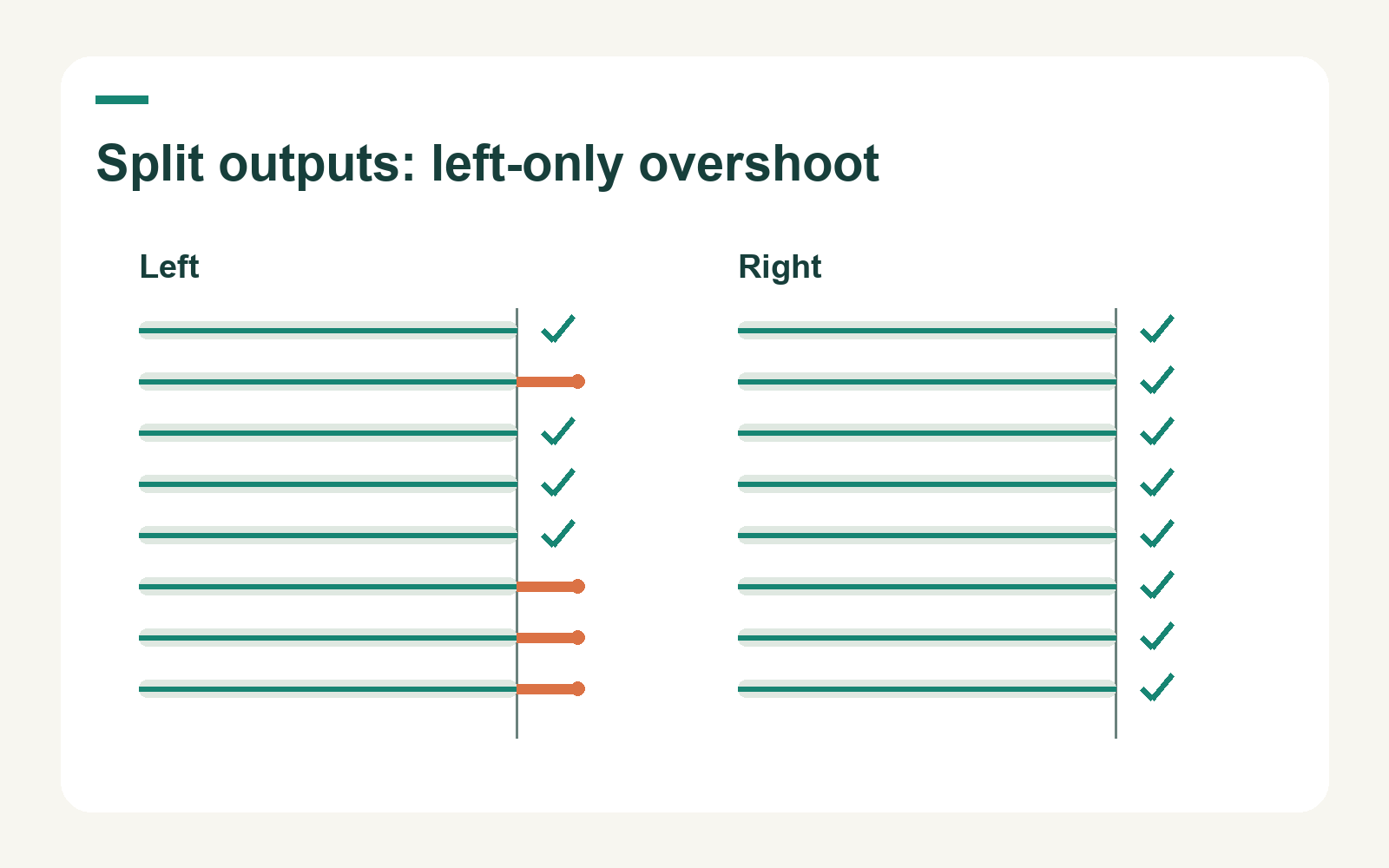
Row 5 is the cleanest of the eight. Its cut sits inside the inserted two-second silence, both endpoints stay within their own input, and no missing word is confirmed for it. The other seven rows either overshoot on the left half or carry a whole-only span that no independent listening has settled.
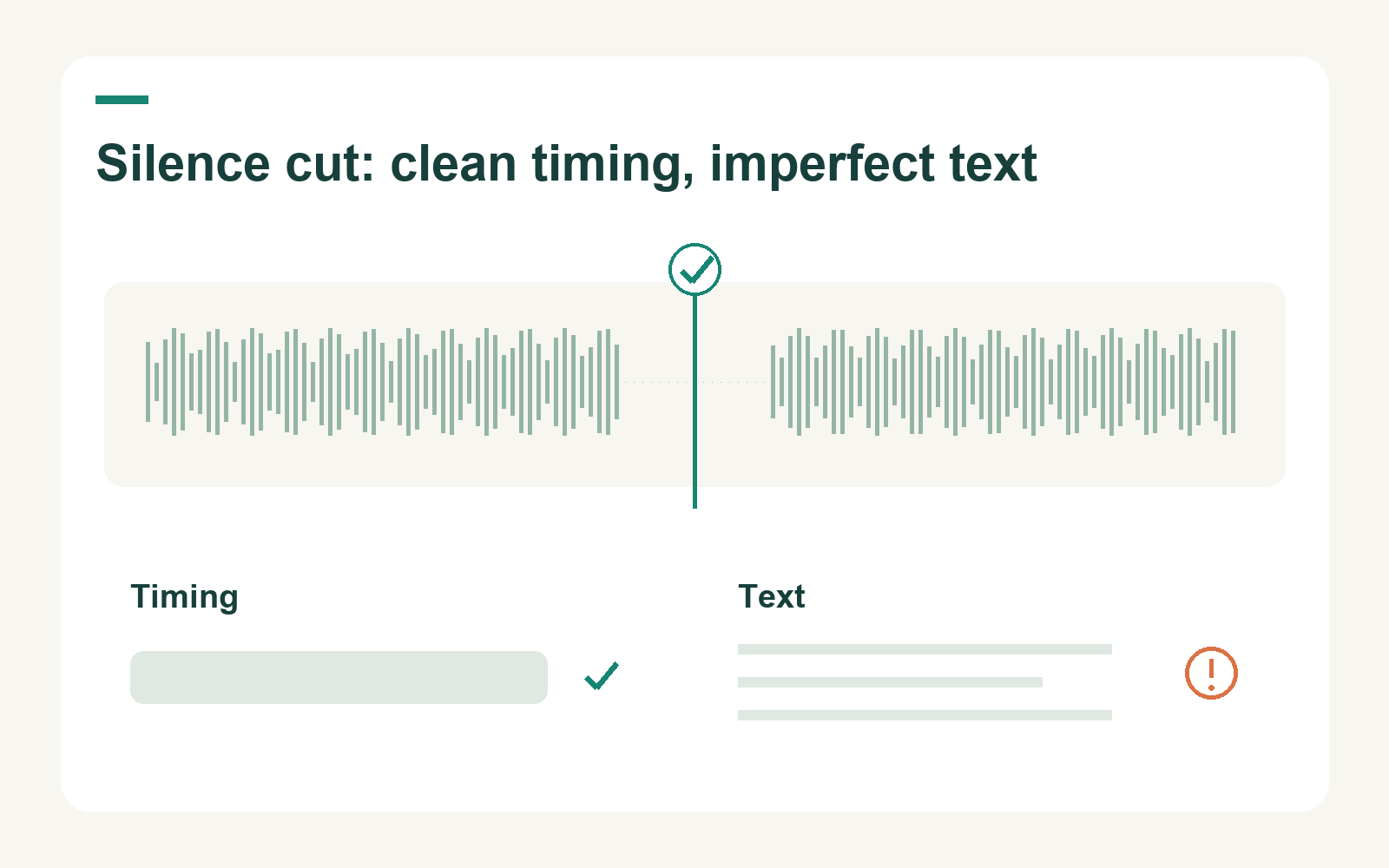
Each whole-file run returned the same 435 words and ended at 183.0 s against a 182.961 s input, 0.039 s beyond its own duration. That figure belongs to the whole-file axis only and is not mixed into the split rows above.
| Row | Left words | Right words | Left cut sample (16 kHz) | Right cut sample (16 kHz) |
|---|---|---|---|---|
| 1 | 15 | 420 | 82663 | 2844720 |
| 2 | 83 | 354 | 536589 | 2390794 |
| 3 | 133 | 300 | 850416 | 2076967 |
| 4 | 160 | 277 | 1032516 | 1894867 |
| 5 | 209 | 227 | 1398939 | 1528444 |
| 6 | 225 | 211 | 1508844 | 1418539 |
| 7 | 275 | 160 | 1839979 | 1087404 |
| 8 | 352 | 83 | 2330171 | 597212 |
One reading per row
Every row is read the same way: the missing-word column records a whole-only span only where one exists, and the timestamp column puts each split endpoint against that input's own duration. A whole-only span is not proof of a spoken-word omission, because no independently listened reference transcript exists for this recording.
The whole-file output, verbatim
All eight whole-file text outputs were identical. This is their uncorrected text, displayed and counted once; separate split outputs and segment timestamps are preserved in each row's original-output file.
At the small recording room, the editor laid a blue notebook beside the microphone and checked the level before starting the interview. Nobody changed the settings during the recording. Each speaker waited until the previous sentence had finished, although the room was never completely quiet. A clock clicked in the corner, and a delivery cart passed the open door. Tomorrow the team would compare the original recording with a transcript made from separate pieces. They wanted to keep the names, quantities, and final words of each instruction intact. The first instruction was to play 17 numbered cards on the table, leaving a small space between every pair. The second instruction asked the visitor from Rotterdam to read the address slowly and then repeat the building number. An assistant wrote the words on a paper form while another person checked the printed map. There was no disagreement about the destination, but the street name was unfamiliar to everyone except the visitor. Before continuing, the editor asked for a short pause. The notebook stayed open, the microphone remained in place, and nobody added music or changed the playback speed. This part of the exercise ended with a complete sentence. The next part would begin after a clearly separated interval of silence. After the pause, the visitor explained that the package needed a signature because the receiving office would close early that afternoon. A handwritten note listed the number of boxes, their labels, and the name of the person who would collect them. The editor read the note once without stopping. 94 small labels were packed in the first envelope, while the second envelope contained the return instructions. The visitor asked the assistant to keep those two envelopes apart until the courier arrived. Nobody suggested changing the order of the steps. Every box needed its own label before it could leave the room. Finally the assistant checked the last line against the notebook and read it aloud. The instructions said to call the office after delivery, record the time, and leave the receipt in the upper drawer. The editor then repeated the destination and asked everyone to remain silent until the recording had stopped. A final check concerned the blue notebook itself. It's first page contained the address, its second page listed the quantities, and its last page held the signature field. The assistant closed the notebook only after confirming that the receipt had been placed inside. This controlled narration is a prepared recording for a local speech recognition comparison. It is not a report about an actual shipment, a customer interview, or a recording downloaded from INSTagram.
Scope of the result
The table does not establish a universal safe cut point. Capitalization and punctuation changes are retained instead of being silently corrected. The whole-only phrase is a transcript mismatch, not proof that the recognizer lost those spoken words. Both audio and recognizer outputs remain available for an independent listening check. No Instagram limit, production upload function, or model-wide accuracy rate was tested.
The raw evidence includes the source waveform, synthesis script and events, eight cut definitions, all twenty-four recognizer outputs, and the comparison script. Chunk times remain local to each input. No timestamp shifted onto the full recording is represented as a raw timestamp. Repeated words quoted in the table and the full transcript receive no additional numerator credit.