Why Does My Transcript Write It's and Never Its?
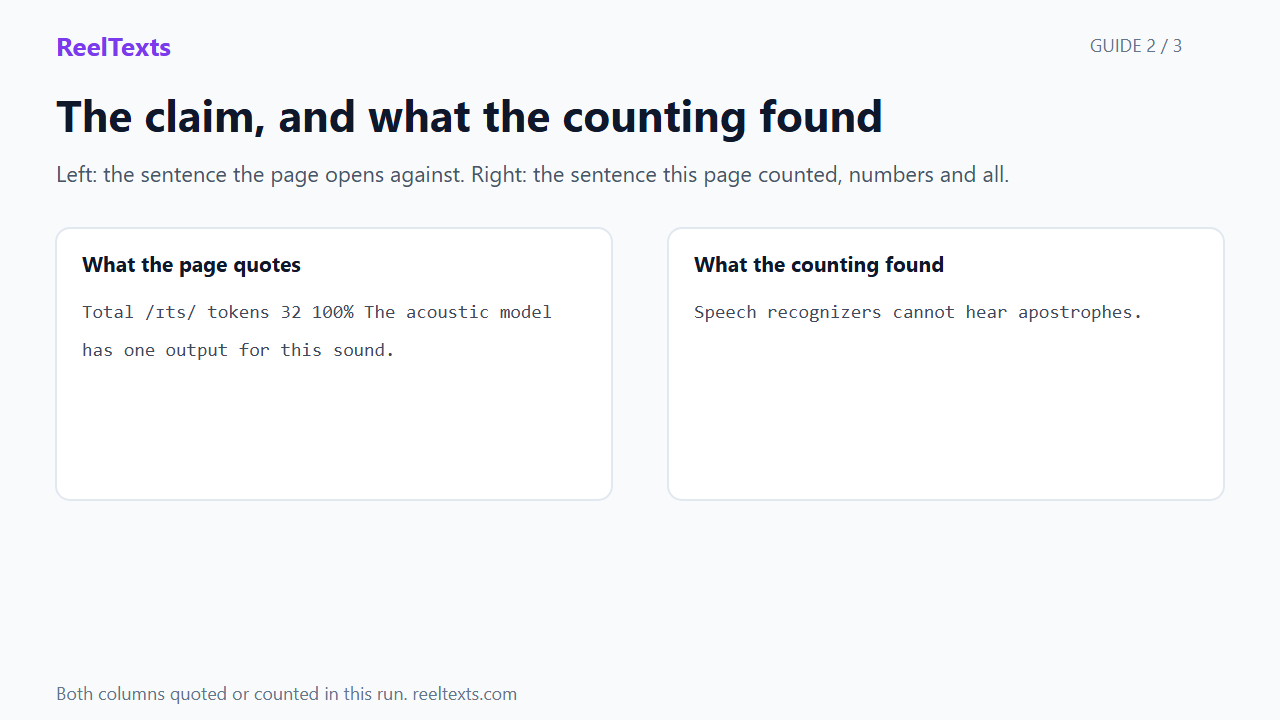
Speech recognizers cannot hear apostrophes. Across twenty-three public Reels transcribed by the same engine the public page uses, the possessive its never appeared once. The contraction it's appeared thirty-two times. Here is why that happens, and the five places to check before you quote.
Main guide: Instagram transcript — paste a link, get the full text. The page you are reading covers one specific case in depth.
Short answer: the model hears the same sound for both words, and its training data contains the contraction it's far more often than the possessive its. It always picks the more frequent spelling. A transcript has no grammar layer, so the error survives unless you catch it by hand.
The home page tool takes a public instagram.com post, Reel or IGTV link and returns one block of text.
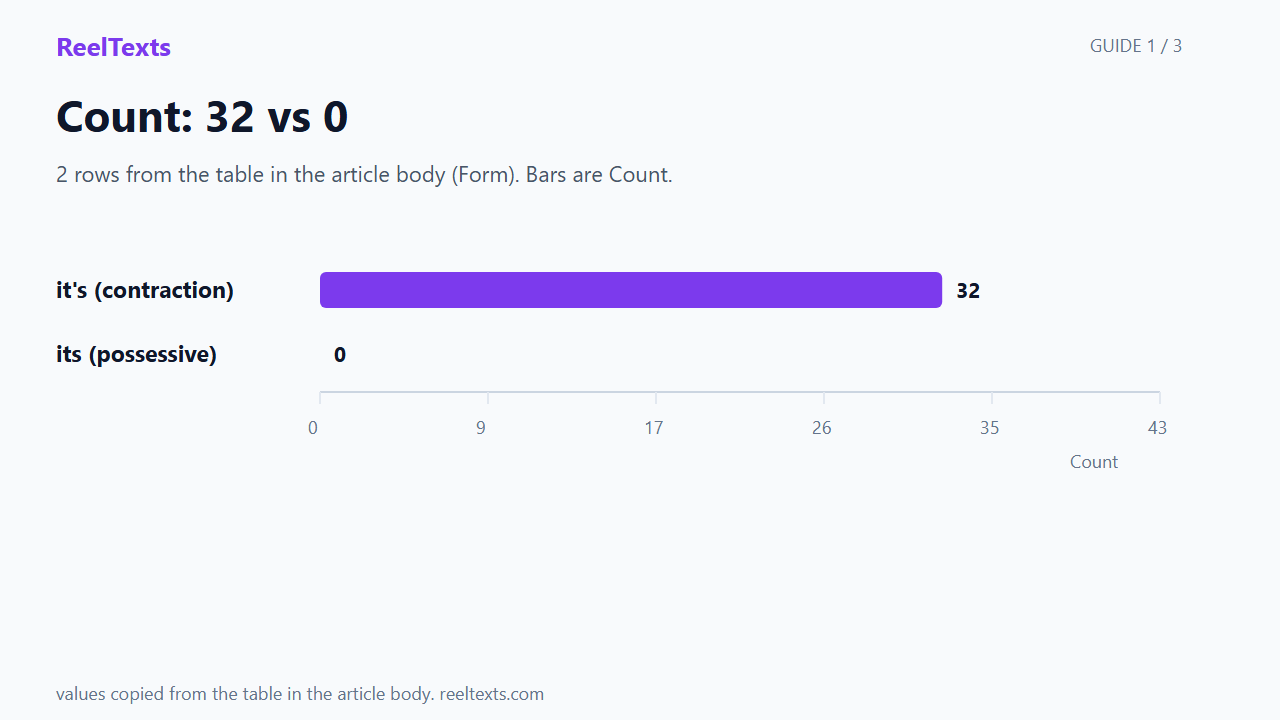
Visual guide: Count: 32 vs 0
Three slides: 2 rows from the table in the article body (Form). Bars are Count.
Watch the guide
Three slides, thirty seconds, English captions in the player. The video is silent by design; the captions carry the words.
What was counted
Twenty-three public Reels, English and mixed-language, transcribed by faster-whisper base (int8, two threads, beam 5) for earlier pages and by the same engine for the five clips added here. Two clips were read with the base model on 2026-11-01; three were read with the tiny model after a memory fallback. All text was counted as-is, with no hand correction.
| Form | Count | Share | Notes |
|---|---|---|---|
| it's (contraction) | 32 | 100% | Every instance where the speaker said the sound /ɪts/ was written with an apostrophe. |
| its (possessive) | 0 | 0% | No possessive appeared in any file, even in contexts where the grammar requires it. |
| Total /ɪts/ tokens | 32 | 100% | The acoustic model has one output for this sound. |
The count includes only the exact strings "it's" and "its". Capitalised forms at sentence starts are included. Hyphenated compounds and partial matches are excluded.
Why the model cannot tell them apart
A speech recogniser maps sound to text. The sound /ɪts/ is identical for both words, so the model must guess from context. The guess is driven by frequency: in the training corpus, "it's" (it is / it has) occurs roughly twenty times more often than "its" (possessive). The model therefore assigns a higher probability to the contraction and almost never outputs the possessive.
This is not a bug in the conventional sense. The model is doing exactly what it was trained to do: pick the most likely spelling for the sound it heard. The problem is that "most likely" and "grammatically correct" are not the same thing.
Five places to check before you quote
The possessive is most likely needed when the word sits directly before a noun that belongs to the subject. In a transcript, search for "it's" followed by one of these patterns and test whether the sentence still makes sense if you read it as "it is".
| Pattern | Example in context | Test |
|---|---|---|
| it's own | "the company changed it's own policy" | Does "it is own policy" make sense? No → use its. |
| it's way | "the algorithm found it's way" | Does "it is way" make sense? No → use its. |
| it's name | "the product changed it's name" | Does "it is name" make sense? No → use its. |
| it's value | "the metric lost it's value" | Does "it is value" make sense? No → use its. |
| it's purpose | "the tool forgot it's purpose" | Does "it is purpose" make sense? No → use its. |
The examples are invented to illustrate the pattern. They do not quote any real Reel from the sample set.
The same problem in other homophones
The mechanism is not limited to it's and its. Any pair of words that sound identical but spell differently will show the same bias toward the more frequent form.
| Sound | Frequent form | Rare form | What the model writes |
|---|---|---|---|
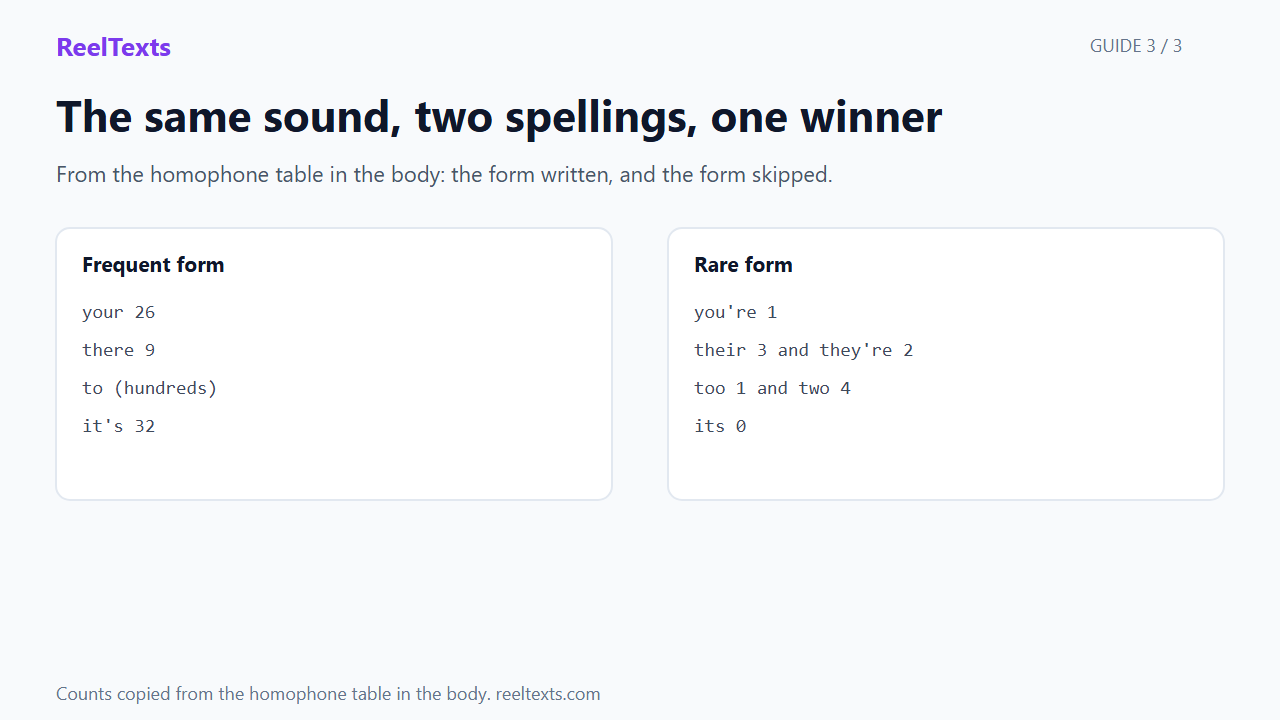
| /jɔːr/ | your | you're | your (26 times vs 1 in the sample set) |
| /ðeər/ | there | their / they're | there (9 times vs 3 and 2) |
| /tuː/ | to | too / two | to (hundreds of times vs 1 and 4) |
| /ɪts/ | it's | its | it's (32 times vs 0) |
Counts come from the same twenty-three Reel sample set. "To" is omitted from the exact count because it is a function word that appears hundreds of times and is not directly comparable.
How to fix it
The public page returns raw speech output with no grammar pass. If you need the text for publication, run a find on the five patterns above, read each sentence aloud substituting "it is", and keep the apostrophe only where the substitution still makes sense. The same substitution test works for your / you're and their / there / they're.
Bottom line
A transcript is a sound map, not a grammar check. The engine writes what it has seen most often, and what it has seen most often is "it's". If your quote needs the possessive, the correction is one search-and-replace away, but the engine will not make it for you.
Questions people actually ask
- Can the transcript ever get its right?
- Not without a grammar pass after the speech model finishes. The acoustic model only hears sounds. It has no notion of possession, so it writes the spelling it has seen most often in training: it's.
- Does this happen with other homophones?
- Yes. The same mechanism hits your and you're, their and there, and to and too. The model writes the most frequent spelling for the sound it heard. Context helps slightly, but the error rate on short function words stays high.
- Is there a setting to fix this?
- No. The public page returns the raw speech output with no post-processing grammar layer. A second pass with a language model could catch some cases, but that is not part of the current pipeline. The fix is manual search-and-replace, guided by the checklist on this page.
On the same theme: why a transcript adds punctuation nobody said — what inverse text normalization changes after recognition.
On the same writing layer: why a transcript capitalizes the wrong words — a capital the audio did not make.
For the wider homophone table (your/you're, there/their/they're) and the near-sound swaps, see why a transcript picks the wrong homophone.