Instagram to Text: How Many Characters One Reel Returns
The useful question before pasting a link is not how long the Reel is, but how much text comes back. Five Reels were run here, from 26 seconds to two and a half minutes, and the yield is steady enough to plan against.
Main guide: Instagram transcript — paste a link, get the full text. The page you are reading covers one specific case in depth.
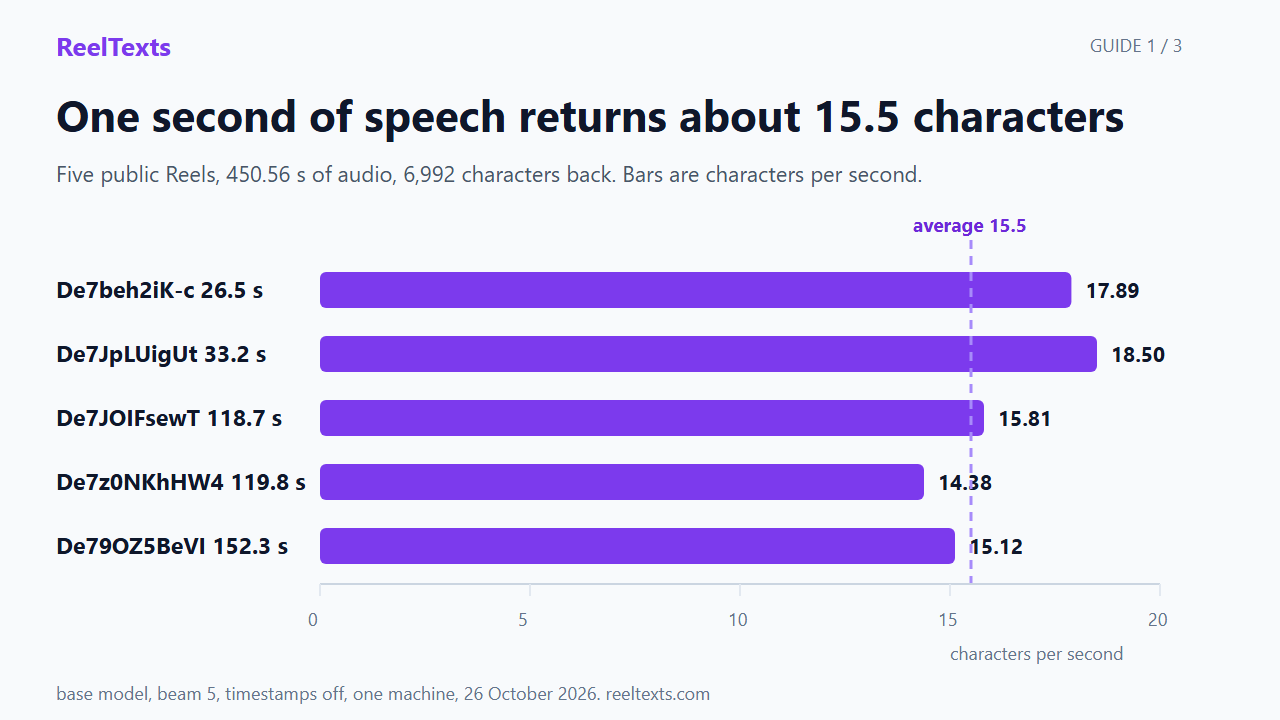
Short answer: one second of speech comes back as about 15.5 characters. Five Reels totalling 450.56 seconds returned 6,992 characters, between 14.4 and 18.5 characters per second. A 30-second Reel lands near 466 characters; a 60-second Reel near 931. Because the text carries no timecodes, characters are the only budget you can count before you run anything.
Visual guide: what 450.56 seconds of speech returned
Three slides: the rate, what the text is missing, and what the characters are made of.
Watch the guide
Three slides, thirty seconds, English captions in the player. The video is silent by design; the captions carry the words.
Same guide on YouTube: Instagram to Text: How Many Characters One Reel Returns
Five Reels, measured one at a time
Every clip below was public and English, run once through this site's engine on 26 October 2026: base model, beam 5, timestamps off. Length is the decoded audio the engine read, not the duration printed on the post.
| Clip | Length | Words | Characters | Characters per second | Words per minute |
|---|---|---|---|---|---|
| De7beh2iK-c | 26.50 s | 79 | 474 | 17.89 | 178.9 |
| De7JpLUigUt | 33.24 s | 102 | 615 | 18.50 | 184.1 |
| De7JOIFsewT | 118.72 s | 345 | 1,877 | 15.81 | 174.4 |
| De7z0NKhHW4 | 119.81 s | 286 | 1,723 | 14.38 | 143.2 |
| De79OZ5BeVI | 152.30 s | 412 | 2,303 | 15.12 | 162.3 |
Five clips, 450.56 seconds of audio, 6,992 characters. Characters are the length of the returned string, spaces included. Duration measured from the decoded audio at 32,000 bytes per second.
Two clips that returned almost nothing
Two more Reels were run the same way and are part of the answer. De71oKBiLUO (23.0 seconds) came back as two words and De74vp9huQ8 (40.8 seconds) as five: neither carried speech the English model could use, and what did come back was punctuation and a fragment. Read those as a zero, not as a bug. The rate above describes clips with talking in them; a Reel built on music, captions burned into the picture, or applause returns a near-empty string and no amount of waiting changes that.
What the 6,992 characters are made of
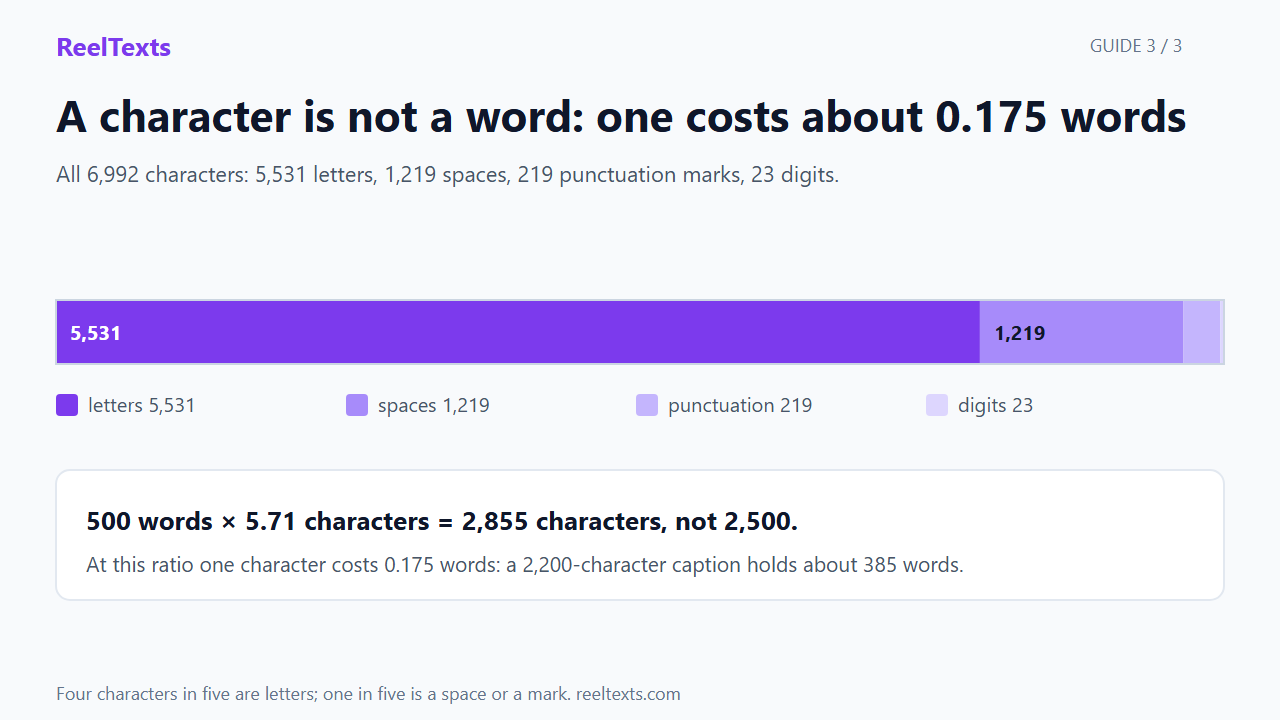
The five transcripts break down as 5,531 letters, 1,219 spaces, 219 punctuation marks and 23 digits, which adds up to exactly 6,992. So roughly four characters in five are letters, and about one in five is a space or a mark.
That gap matters when a limit is written in characters and a plan is written in words. At the ratio measured here, one character costs about 0.175 words, so a 500-word script is roughly 2,855 characters, not 2,500. Writers who budget a 2,200-character caption in words usually overshoot by a third of a paragraph.
Why there is no timing to budget against
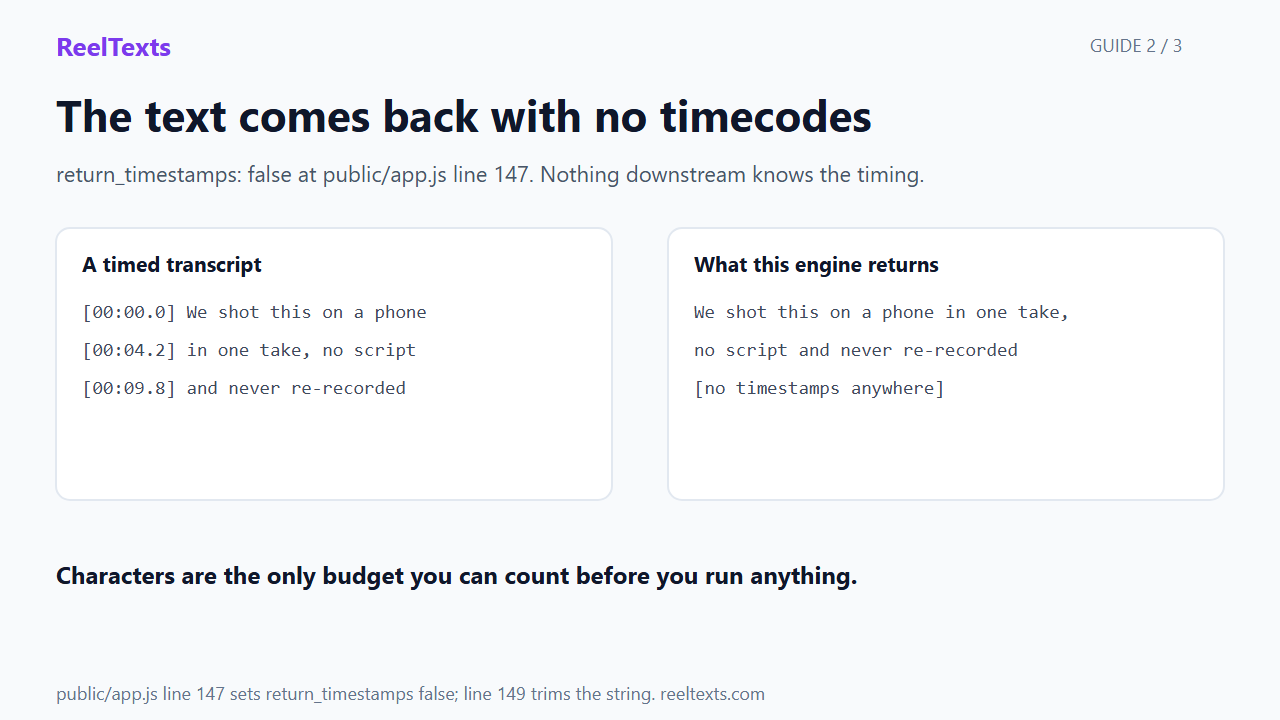
The engine is asked for text only. return_timestamps: false at public/app.js line 147 tells the model to return one string rather than segments with start and end times, and line 149 trims that string before it reaches the page. Nothing downstream knows where a sentence sat in the clip. That is why the character count is the only quantity you can predict, and why any per-line timing you see elsewhere was added afterwards by arithmetic.
How long a Reel can be before the text stops fitting
The point of a rate is that it runs backwards. Divide a limit by 15.5 characters per second and you get the length of Reel that fills it.
| Where the text is going | Limit in characters | Reel length that fills it |
|---|---|---|
| A short post | 280 | 18 s |
| An Instagram caption | 2,200 | 2 min 22 s |
| One spreadsheet cell | 32,767 | 35 min |
Arithmetic at 15.5 characters per second, not a measurement of those fields. Field limits are the documented ones and they change; the measured side of the sum does not.
Use the band rather than the average when the answer is close. At the measured extremes the 2,200-character line moves between 1 minute 59 and 2 minutes 33, which is the difference between a Reel that fits and one that has to be cut.
Getting the same number for your own Reel
Four steps, and the whole check takes about as long as the clip. Copy the Reel's link from the share sheet. Paste it in and wait for the text. Move the text into any editor that shows a character count, and divide that count by the clip's length in seconds. Then read the result against this page: between 14 and 19 characters per second is what five clips produced here.
Two readings that mean something specific. Well under 10 characters per second usually means the clip is mostly music or silence, or that only part of it was transcribed. Well over 22 usually means a repeated block, which is what a stuck decode looks like in text. Neither is visible if you only count words.
Where the rate does not hold
The two short clips ran faster than the three long ones: 17.89 and 18.50 characters per second under 34 seconds, against 14.38 to 15.81 above 118 seconds. Two clips on each side is a hint, not a rule, and the long ones have room for pauses. What the sample does support is the band, not a single number: plan with 14 to 19 characters per second and the estimate survives a slow speaker, a pause and a two-minute Reel.
Questions
- How many characters is a one-minute Reel?
- About 931 at 15.5 characters per second, and between 863 and 1,110 at the extremes measured here. That is one minute of speech; a minute of music returns almost nothing.
- Can I work out how long a Reel is from its character count?
- Roughly, by dividing characters by 15.5. The answer inherits the whole spread of the band, so treat it as a check on a number you already know rather than a measurement.
- Does the text come back with timestamps I could budget against?
- No. The model is called with
return_timestamps: falseatpublic/app.jsline 147, so it returns one string with no segment times. Timing has to be added afterwards, and anything added afterwards is an estimate.
Affiliate link: Notta is a separate service that transcribes audio and video files you upload. This site earns a commission if you subscribe through that link, at no extra cost to you.