Free TikTok Transcript Extractor: What the Tools Actually Return
Looking for a free TikTok transcript extractor? This page examines what the checked tools actually show; ReelTexts itself does not process TikTok links.
Main guide: Instagram transcript — paste a link, get the full text. The page you are reading covers one specific case in depth.
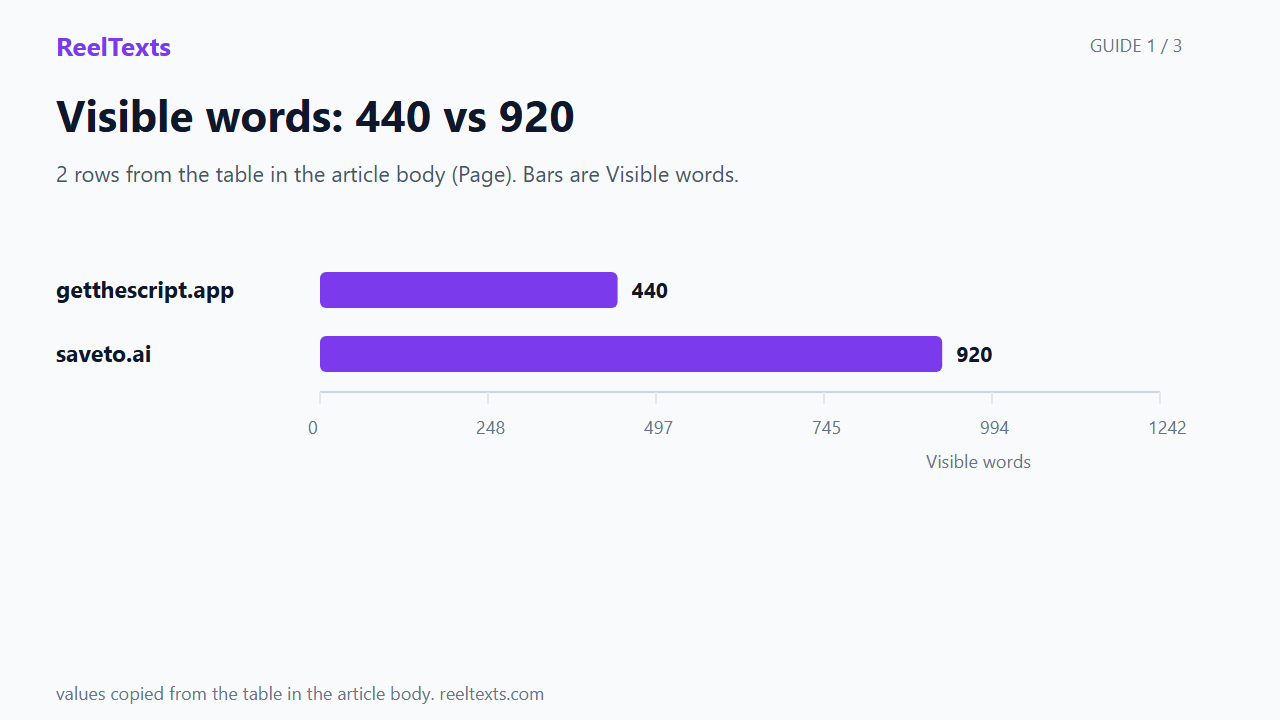
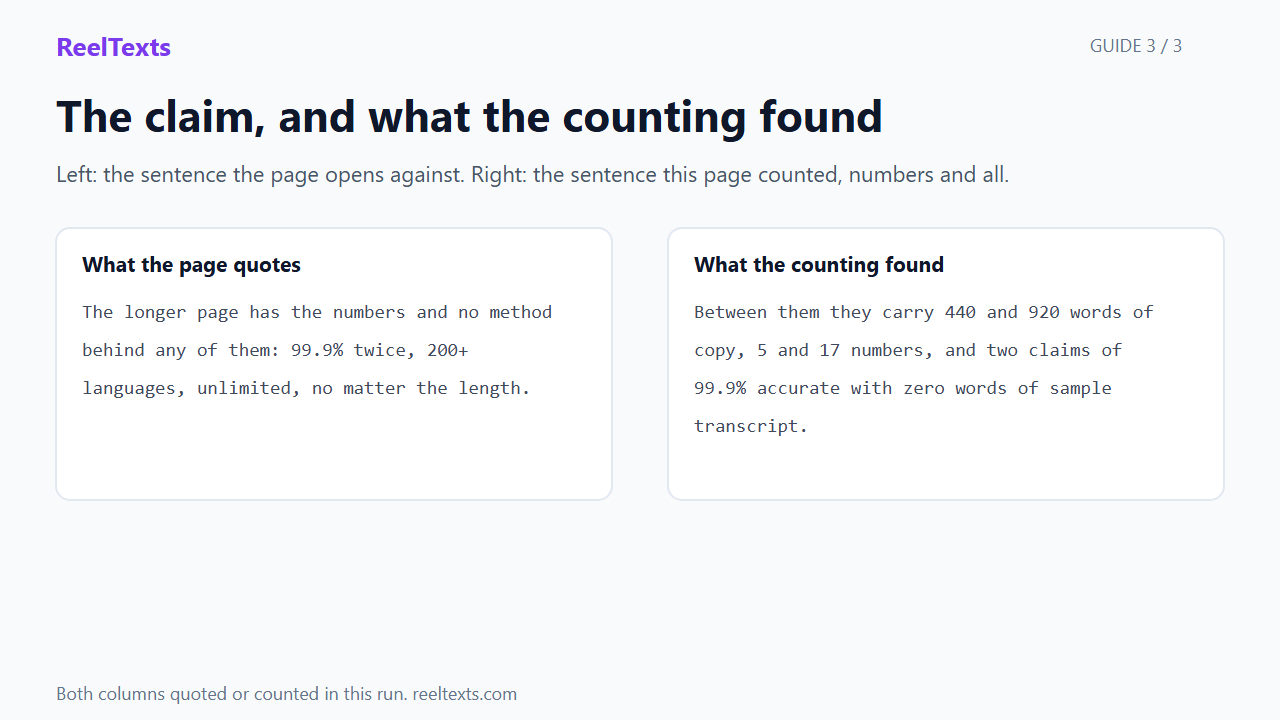
Short answer: you get one block of plain text, and the two pages checked here never show a word of it. Between them they carry 440 and 920 words of copy, 5 and 17 numbers, and two claims of “99.9% accurate” — with zero words of sample transcript. The output is smaller than the pitch: three clips measured on this machine returned 172 to 183 words per minute of audio, as one string with no timestamps and no speaker names.
Visual guide: Visible words: 440 vs 920
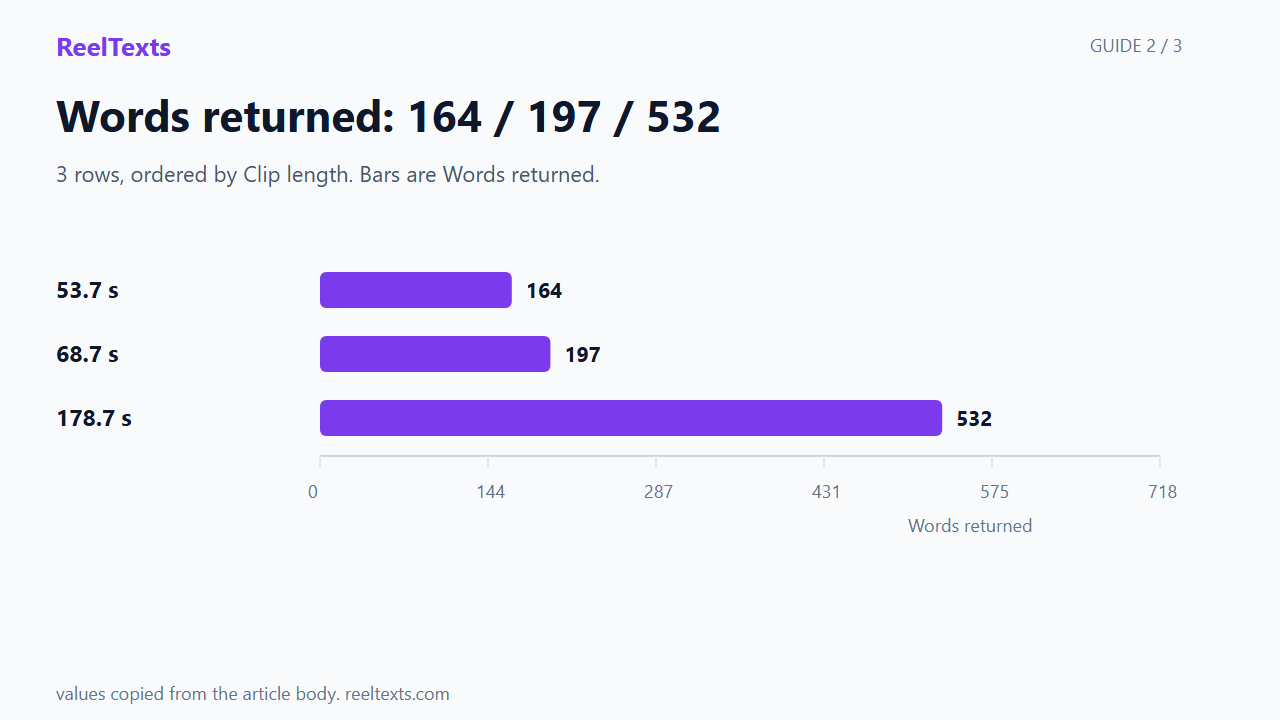
Three slides: 2 rows from the table in the article body (Page). Bars are Visible words.
Watch the guide
Three slides, thirty seconds, English captions in the player. The video is silent by design; the captions carry the words.
What the two pages actually contain
Both were fetched in full on 25 October 2026 at 09:45 Beijing time, HTTP 200, and counted on the visible text as served, menus and footer included.
| Page | Visible words | Numbers stated | Words of sample transcript | Accuracy claim | Length limit stated |
|---|---|---|---|---|---|
| getthescript.app/tiktok-transcript | 440 | 5 | 0 | none | none |
| saveto.ai/tiktok-transcript-generator | 920 | 17 | 0 | “99.9%”, twice | “no matter the length” |
One fetch per page, desktop user agent, scripts and styles stripped, text split on whitespace. “Numbers stated” counts any token containing a digit, so step labels count too.
The shorter page gives three steps and offers TXT, SRT and VTT, with one sentence about mechanism: “We read the video audio — and on-screen captions where available — and turn the speech into text.” Reading burned-in captions and reading audio fail differently, and the page never says which one produced a line.
The longer page has the numbers and no method behind any of them: 99.9% twice, 200+ languages, unlimited, “no matter the length”. A transcript page with no transcript on it asks you to trust a percentage you cannot check.
The only text TikTok hands a machine
TikTok's oEmbed endpoint answered three queries for this page, against three public video IDs: HTTP 200 each, the same nine fields every time — version, type, width, height, html, provider_url, provider_name, embed_product_id, embed_type. None of the nine holds spoken words, a caption track or a transcript; the html field is 332 characters of iframe. A generator starting from a TikTok link starts from a video it has to fetch and audio it has to listen to.
What a minute of speech turns into
Three clips went through this site's engine on 23 October 2026, output saved unedited. They are Instagram Reels, not TikToks: this machine cannot fetch TikTok media, and what transfers is the speech rate, which belongs to talking rather than to a platform.
| Clip length | Words returned | Characters | Words per minute | Characters per word |
|---|---|---|---|---|
| 53.7 s | 164 | 918 | 183 | 5.60 |
| 68.7 s | 197 | 1,087 | 172 | 5.52 |
| 178.7 s | 532 | 2,846 | 179 | 5.35 |
One run per clip, 16 kHz mono, small English model on one CPU thread, text saved as returned. Words by whitespace, characters with spaces. Log: Claw/work/daily-2026-10-23/ttfw.json.
The block carries no timestamps, so nothing points back to a moment in the video, and no speaker labels, so a quoted line cannot be attributed from the text. The wait is not proportional either: first word at 11.24, 11.88 and 11.90 seconds, whole clip at 20.67, 30.75 and 172.3. A second run on the shortest clip returned the same 164 words and 918 characters in 20.55 seconds — the text does not drift, the waiting does.
What this box does with a TikTok link
Pasting a tiktok.com URL into this site's own endpoint returns HTTP 400 in 8.1 milliseconds: “Please paste a public instagram.com link (a post, Reel, or IGTV).” A youtube.com link gets the same answer in 3.5 milliseconds. The check is a host test at server.py lines 127 to 130, the rejection at lines 558 to 559. This page is not a claim that the box transcribes TikTok; it does not. The numbers above come from the same engine on downloaded clips.
A sixty-second test for any free TikTok transcript generator
Pick a thirty-second TikTok you have watched twice. Paste the link with a stopwatch running, note the first word, copy the text. At 172 to 183 words per minute, thirty seconds should land between 86 and 92 words: far fewer means a cut tail, far more means the model looped. Paste a music-only clip next; the right answer is that no speech was found.
Questions
- Why is 99.9% accuracy not a useful number?
- No method is attached to it, and the number describes an average rather than your words. At 180 words a minute, 0.1% is one wrong word in a thousand, about one every five and a half minutes. Errors cluster in names, figures and places, which is the part people quote.
- Does the returned text include timestamps or speaker names?
- In the three clips measured here, no. One string with punctuation, no timecodes, no speaker labels, no confidence marks. SRT and VTT add timings afterwards by arithmetic, spreading words evenly across the clip, which is an estimate and should not be pasted over a quote as if measured.
- What does this site do if I paste a TikTok link?
- It refuses in about eight milliseconds and asks for a public instagram.com link, because the endpoint only accepts Instagram hosts. The measurement on this page was made by running the same engine on downloaded files, not by pasting TikTok links into the box.